This article has been reviewed according to Science X's editorial process and policies. Editors have highlighted the following attributes while ensuring the content's credibility:
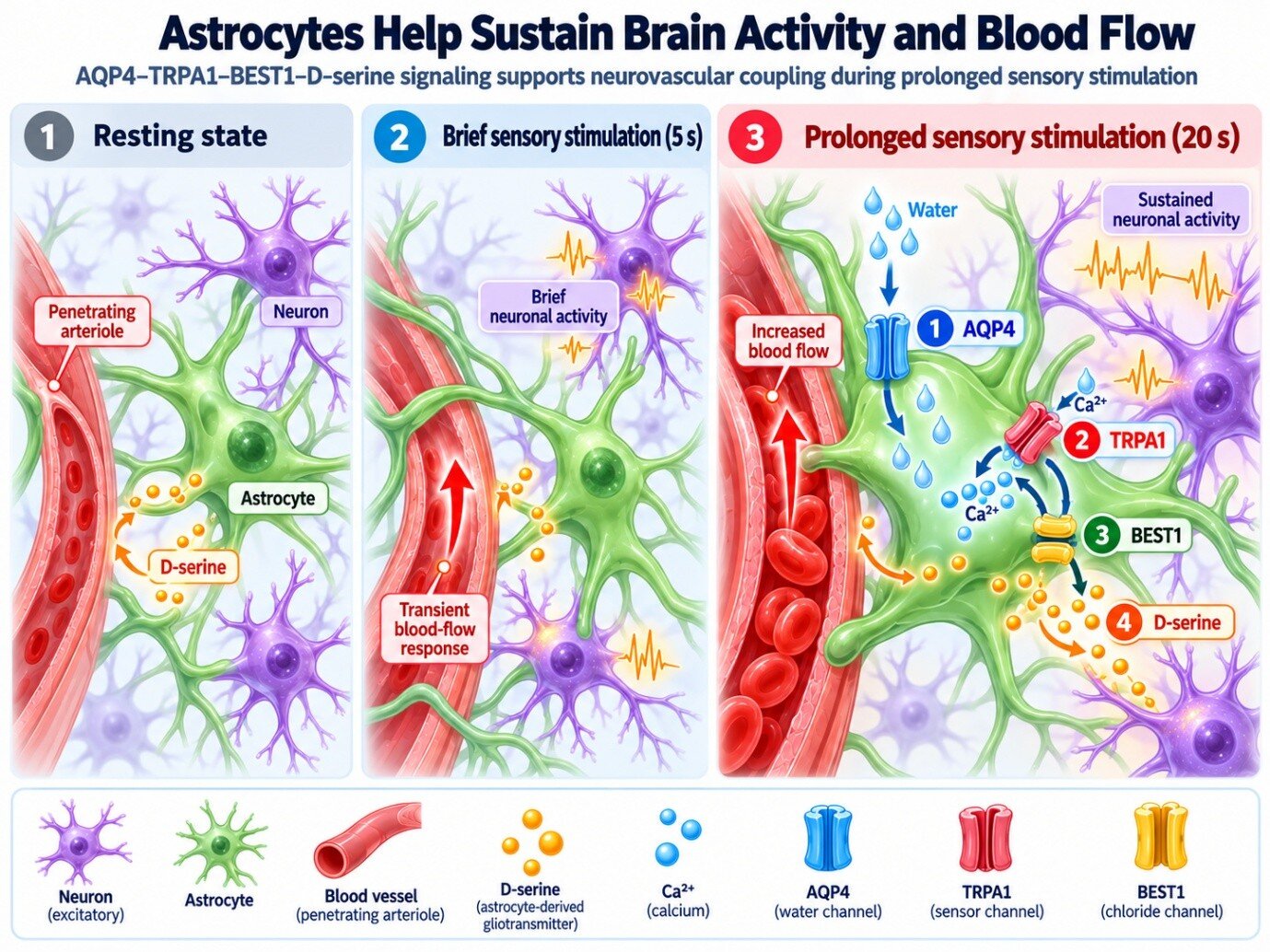
What happens in the brain when sensory stimulation continues over time—for example, while jogging, reading or listening to music? Sensory input activates specific groups of neurons, increasing their demand for oxygen and nutrients. In response, nearby blood vessels dilate and increase blood flow, a process known as neurovascular coupling. Although astrocytes—star-shaped non-neuronal cells in the brain—have long been thought to participate in this process, exactly how they contribute has remained unclear.
A research team led by Director C. Justin Lee of the Institute for Basic Science (IBS) Center for Memory and Glioscience and Professor Suh Minah of Sungkyunkwan University has now shown that astrocytes play a key role in coordinating both neuronal activity and blood-flow responses during prolonged sensory stimulation.
In the journal Advanced Science the researchers identify a signaling pathway involving AQP4, TRPA1, BEST1 and D-serine, and propose a new model in which neurons, astrocytes and blood vessels work together to sustain brain activity when sensory demand continues over time.
Astrocytes are widely distributed throughout the brain and were once viewed mainly as support cells that provide structural and metabolic assistance to neurons. More recent studies, however, have shown that they actively communicate with both neurons and blood vessels and can influence brain function.
To determine whether their contribution depends on how long sensory stimulation lasts, the researchers compared brain responses to brief, 5-second stimulation and prolonged, 20-second stimulation in mice.
Source link