This article has been reviewed according to Science X's editorial process and policies. Editors have highlighted the following attributes while ensuring the content's credibility:
Scientists at Rensselaer Polytechnic Institute (RPI) have developed an artificial intelligence model to streamline and improve screening for Parkinson's disease (PD) so doctors can refer patients for early-stage testing.
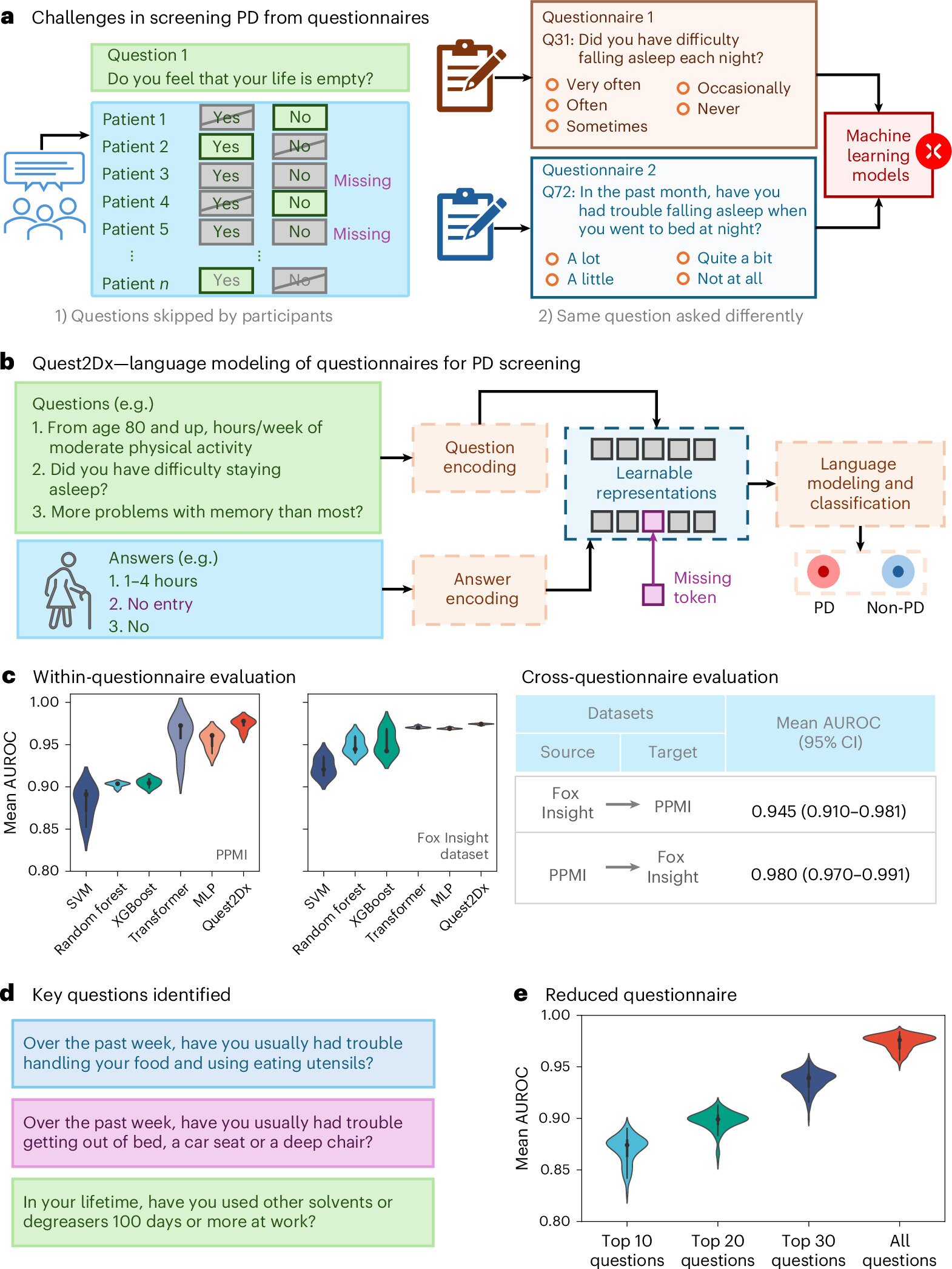
In a paper published in Nature Aging, a team led by Pingkun Yan, Ph.D., head of the Department of Biomedical Engineering at RPI, described how their Quest2Dx AI system was able to analyze lengthy health questionnaires more accurately than other models for early signs of Parkinson's.
Diagnosis of Parkinson's disease relies on observation and measurement of motor symptoms as well as invasive procedures including spinal taps, but the disease may be present for years before physical symptoms appear.
"People with Parkinson's disease get referred to specialists pretty late," Yan said. "We built this AI model to screen for potential cases earlier."
Visual observation has actually been part of the diagnostic process since 1817, when British physician James Parkinson published a seminal essay on the condition that now bears his name, based mainly on watching people walking through a London park. Medical technology has advanced, but the visual aspect has not changed much since then.
, and former RPI doctoral student Diego Machado Reyes—are not trying to diagnose PD, just screen for patients who might need testing years before the physical symptoms Parkinson observed more than 200 years ago are apparent.
Source link