This article has been reviewed according to Science X's editorial process and policies. Editors have highlighted the following attributes while ensuring the content's credibility:
Parkinson's disease is usually thought of as a brain disease, but many patients notice gut trouble—constipation above all—years or even decades before their hands begin to tremble. That timing has led researchers to ask whether the illness sometimes begins in the intestine, and whether treating the gut early could change what later happens in the brain.
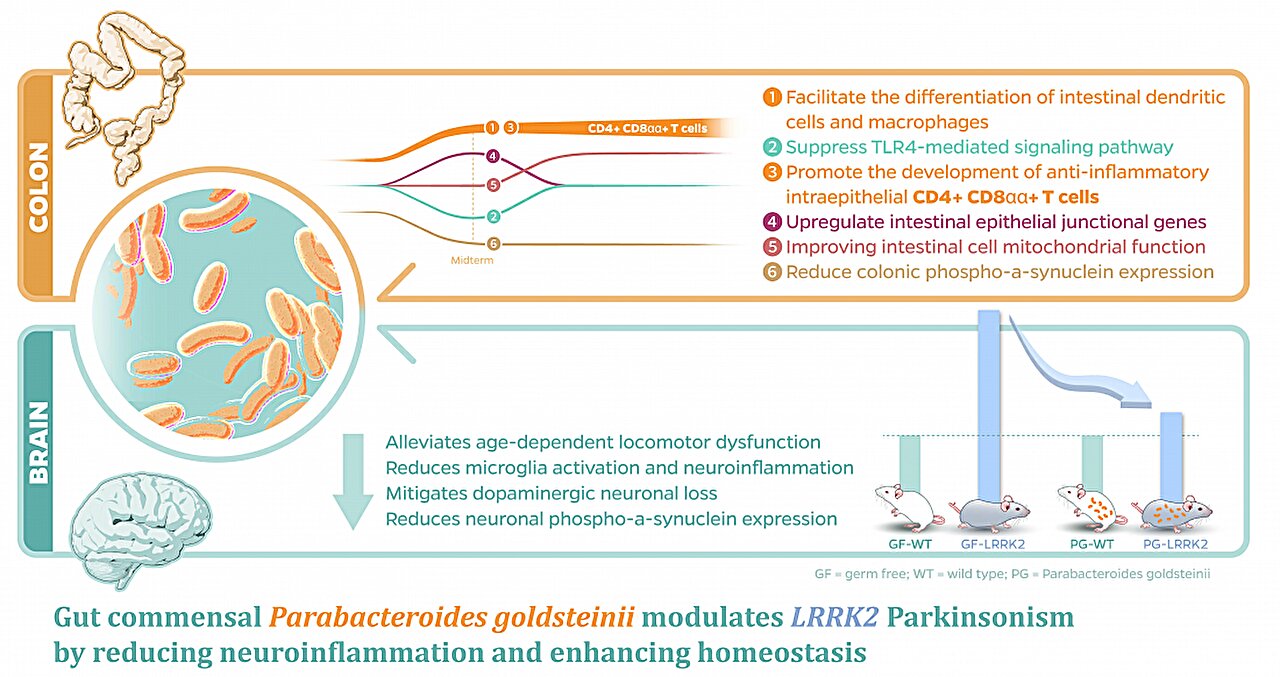
A team at National Taiwan University and National Taiwan University Hospital, working with colleagues at Chang Gung University and the National Laboratory Animal Center, has now tested that idea directly. They studied mice carrying G2019S, a mutation in a gene called LRRK2 that is one of the most common inherited risk factors for Parkinson's disease—and that also raises the risk of inflammatory bowel disease.
The mice were raised completely germ-free, so the researchers could control exactly which bacteria entered their guts. The study is published in the Journal of Advanced Research.
At 5 months of age, before the animals showed any movement problems, some were given a single oral dose of Parabacteroides goldsteinii, a harmless bacterium that normally lives in the human intestine and is found at reduced levels in people with Parkinson's disease. The microbe settled in and persisted for more than a year.
Five months later the difference was clear. Mice that had received the bacterium moved far better than those that had not. Their brains contained fewer clumps of alpha-synuclein —the protein deposits that are the hallmark of Parkinson's disease—showed less activation of microglia, the brain's resident immune cells, and had lost far fewer of the dopamine-producing neurons that control movement.
Source link