

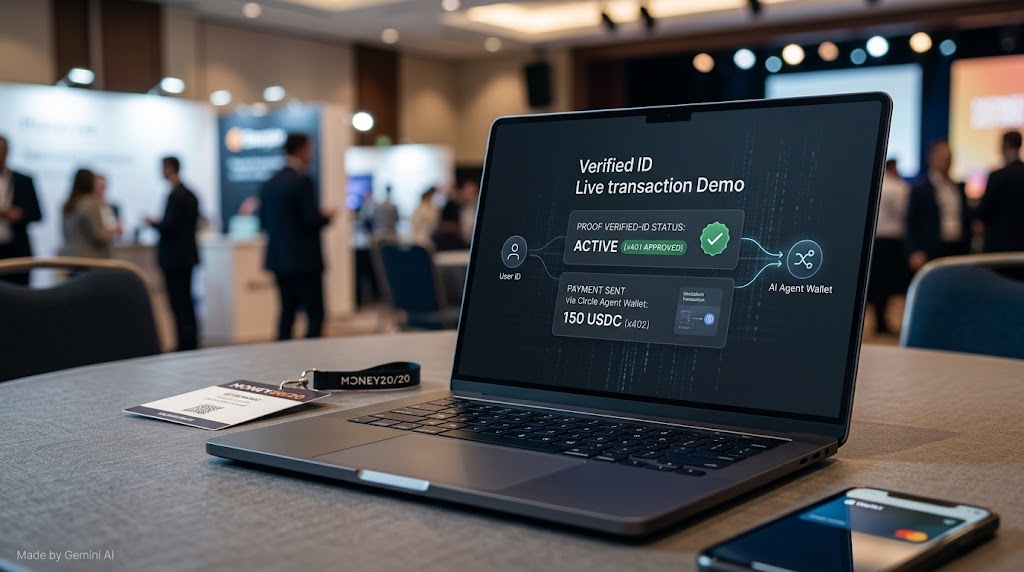
The integration draws on two open HTTP-layer standards. Proof’s x401 protocol, published in June 2026 and moved into production last week, uses the HTTP 401 “Unauthorised” response to let a merchant specify what identity proof it requires and which credential issuers it trusts. Circle’s x402 protocol uses the HTTP 402 “Payment Required” response to specify how the agent should pay. Used in sequence, x401 answers who the agent acts for, and x402 answers how it settles the transaction.
In the demo flow, a merchant responds to an inbound agent request with both an x401 identity requirement and an x402 USDC payment request. The agent’s Proof wallet presents a verified credential derived from identity proofing certified to NIST IAL2 standard, accompanied by a signed, purchase-specific approval. Only the relevant identity facts are disclosed; no full ID document is transmitted or stored by the merchant. The agent then pays from a Circle Agent Wallet in USDC over x402. The merchant retains signed, tamper-evident evidence of who authorised the transaction, which can be used in dispute resolution without requiring Proof to be called again in real time.
A secondary mechanism embedded in the protocol stack is commercially notable. Proof prices identity claims individually, and the same x402 channel can route a micropayment from the merchant to the identity issuer for each verification used. That removes the bilateral contract requirement that has historically limited the reuse of verified identity across ecosystems: a merchant can pay for a check on the spot, at the moment it needs it, without a prior sales relationship with the credential issuer.
Source link