In India, access to banking and payments, alongside participation in formal investment products, is expanding rapidly, driven by fintech advances. Even with these gains, insurance uptake still lags behind, widening the protection gap compared with global standards.
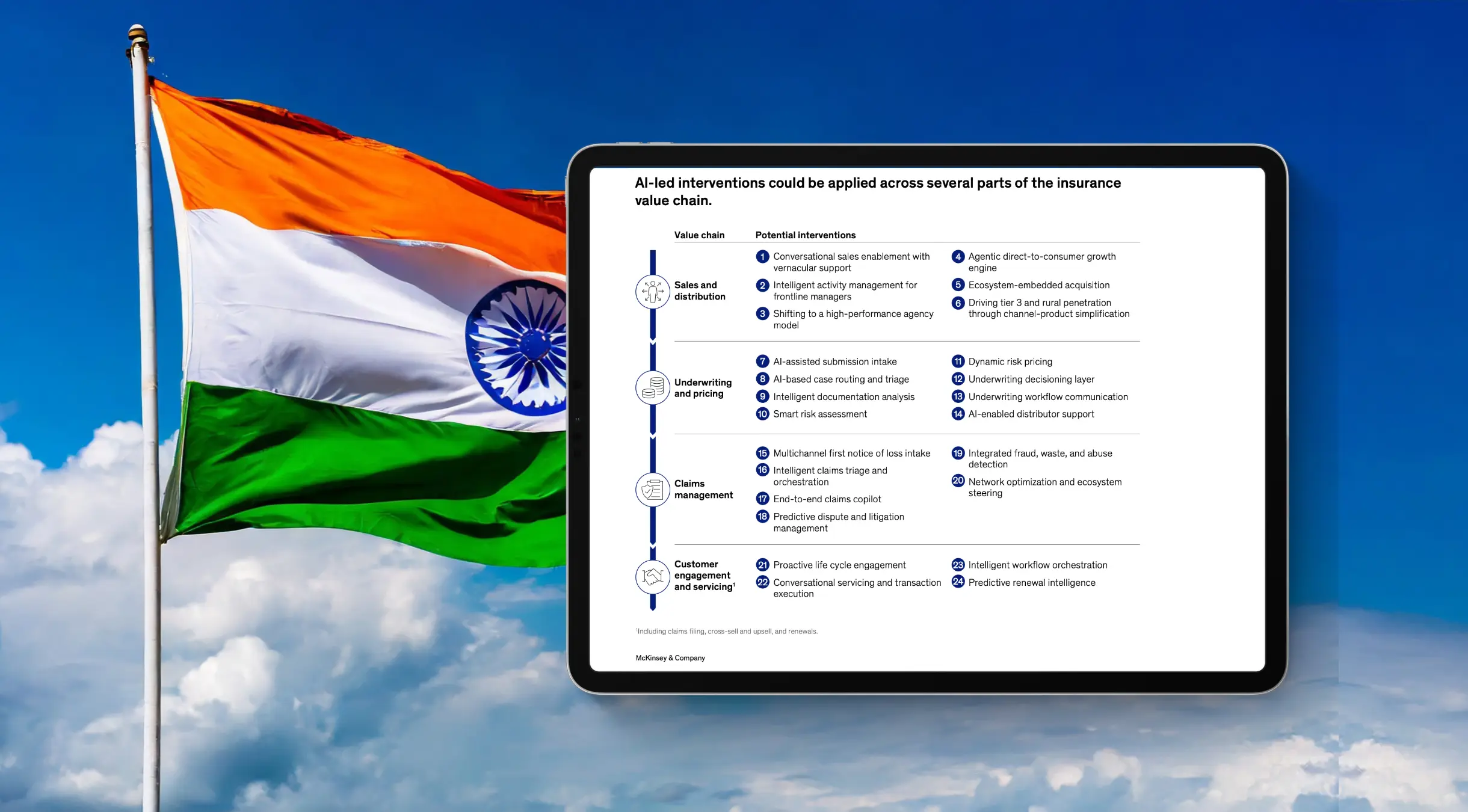
In this context, artificial intelligence (AI) has the potential to reshape India’s insurance sector, easing productivity limits, rising costs, manual work, and customer experience issues, and transforming functions including sales and distribution, underwriting, claims, and customer engagement, according to a new report by McKinsey and Company.
In sales and distribution, frontline distribution remains fragmented, relying on multiple applications, and significant dependence on supervisors for product knowledge, sales support, and customer servicing. These challenges are often amplified in tier 2, tier 3, and rural markets, where digital adoption and language barriers can further constrain advisor effectiveness.
To address these constraints, insurers can leverage conversational, voice-first, and vernacular-enabled engagement models that cut adoption friction, let advisors interact naturally through voice, and bring product guidance, sales support, and frontline workflows into a single intuitive interaction layer.
For frontline leadership, AI can be used to track advisor activity, productivity trends, pipeline movement, renewals, earnings progression, and KPI gaps to show real-time visibility into frontline performance. This allows managers to identify underperformance early, prioritize coaching actions, improve follow-through, and focus attention on the activities most likely to improve outcomes.
Underwriting is another potential area for AI-led transformation across the insurance value chain. A possible future state is a unified underwriting workflow in which intake, enrichment, risk assessment, pricing, approvals, quote generation, and policy issuance are orchestrated through a common workflow, enabling underwriters to focus on judgment, broker and customer engagement, exception handling, and portfolio steering.
Source link