
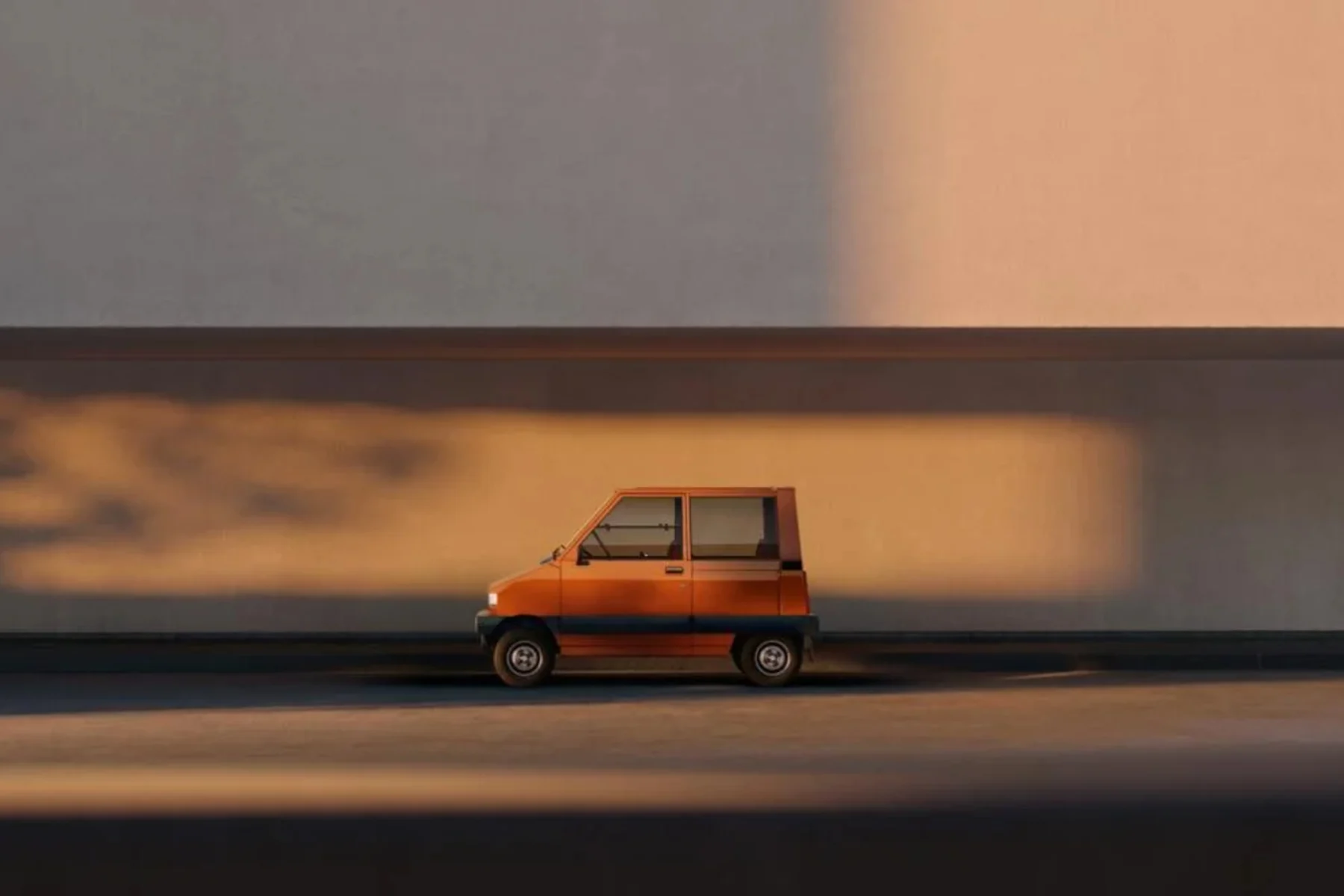
The automotive future arrived in 1976 in butter yellow, drove a maximum of 70 km/h, and needed a ten-hour break after 50 kilometres. Half a century ago, Volvo introduced its first electric car: the Elbil.
In November 1976, Volvo presented its vision of electromobility with the Elbil. A total of two prototypes were built: an orange four-seater and a butter-yellow, two-seat electric delivery van with a sliding door.
The latter was partially funded by the Swedish state and was intended for employees of the then telecommunications authority, Televerket, who were to use it for short, local emission-free trips in the Gothenburg area.
Even back then, Volvo was grappling with a challenge that still drives electric car developers today: weight. While the bonnet and tailgate were made of glass-fibre-reinforced plastic, Volvo used aluminium for the doors and roof panels. The kerb weight was 1,200 kilogrammes.
A 9.5 kW electric motor, compactly integrated into the rear axle by Volvo, provided propulsion. Combined with a specially developed continuously variable transmission, the Elbil achieved a top speed of up to 70 km/h. Power came from twelve 6-volt lead-acid batteries, which provided a range of around 50 kilometres. After that, the vehicle had to be plugged in for ten hours. So, the little Swede was hardly suitable for a spontaneous weekend trip – but then, it wasn’t designed for that.
Half a century later, Volvo’s vision of the electric future looks rather different. The EX60 in its longest-range P12 AWD Electric variant achieves up to 810 km WLTP.
Source link