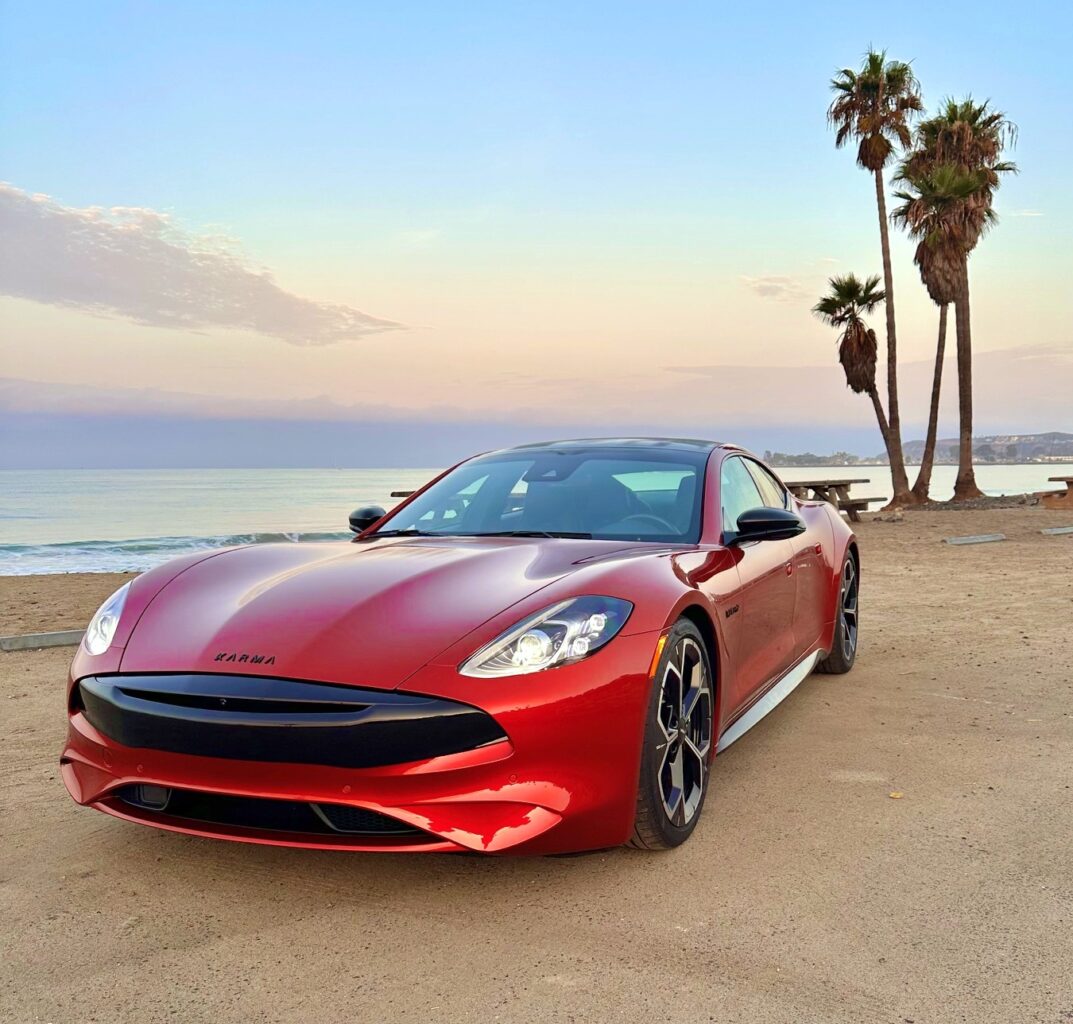
In a sit-down conversation recently at Karma’s Irvine, California, headquarters, Alexa Harnett, vice president global marketing and public relations, said: “Karma is positioning itself as the ultra-luxury American manufacturer…a segment America owned for many, many years. Now when consumers think about ultra-luxury, they think British and Italian brands, so we think there is an opportunity to solidify Karma in this space as the American exotic.”
With this as our starting point, Clean Fleet Report had the opportunity in mid-2026 to drive the 2025 Karma Revero EREV. Why review a previous year car? Simple, it is the last-of-its-kind as Revero production ended a few months ago. The company turns its attention to the Gysera and Invictus sedans, also EREVs, and the Kaveya, a two-door, four-motor, all-electric super sports coupe coming out in late 2027 as a 2028 model.
The Karma Revero is an extended-range electric vehicle (EREV) with a 228 horsepower (hp) BMW turbocharged 1.5-liter inline 3-cylinder gasoline engine powering a generator that charges a 28 kWh lithium-ion battery pack feeding two electric motors. This set-up, for the rear-wheel drive Revero, delivers a combined 536 hp and 550 ft.-lb. of torque.
Karma EREVs are designed so the gasoline engine recharges the battery that then drives the wheels, meaning the wheels cannot be propelled directly by the engine.
6kW onboard charger. It takes 4-6 hours on a Level 2, 240-volt charger. A public DC Fast Charger will add full charge in less than 30 minutes. But unlike a conventional PHEV, where the wheels can be propelled by either the gasoline engine or electric battery, the Revero only moves when the battery has enough charge to drive the rear wheels.
Source link