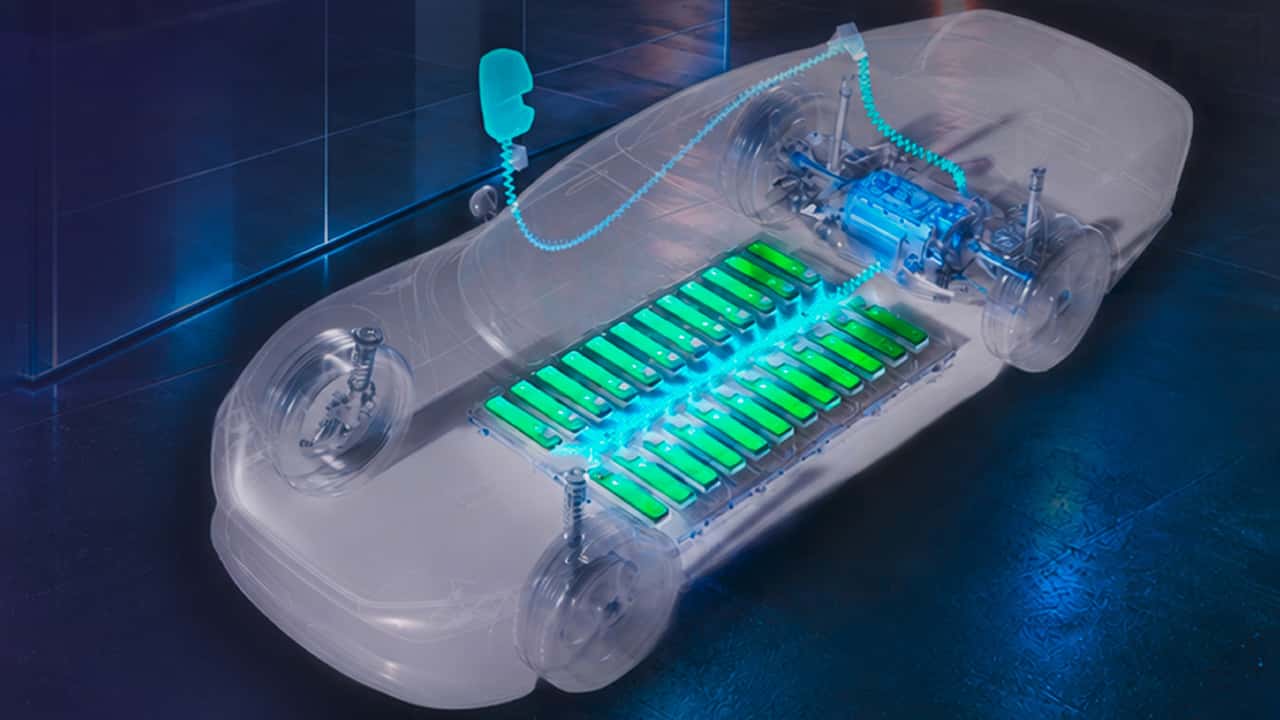
Mercedes-Benz wants to flip the script on how electric car high-voltage batteries work. Its new Power Converter, which is still in the development stage, can control the charge and discharge of individual cells inside the battery, which is a big change from how the vast majority of EV batteries work today.
For decades, traction batteries have had thousands of individual cells, which are arranged into cell groups or modules. The car’s brain can monitor the voltage of each cell or module, but when it comes to charging or discharging, everything gets the same treatment. Does the electric motor require 100 kilowatts? The whole pack delivers 100 kW. Charging at 150 kW? All the cells get treated equally.
With Mercedes’ new technology, however, each cell inside the pack can not only be monitored, but also controlled by a programmable micro-converter. In theory, the approach has a lot of advantages, including prolonging a car’s battery life, using different cell chemistries inside the same pack, and removing bulky power electronics that handle AC and DC conversion.
Let’s look at the longevity aspect first. When an EV battery fails, it’s usually because one or more cells inside the pack can no longer sustain the same voltage as their neighbors. The car throws a scary error message on the screen, and the dealer or service center will recommend replacing the entire battery, which costs a lot of money if the warranty has run out.
With Mercedes-Benz’s new approach, if a cell can no longer sustain the required voltage, it can be simply disabled by its micro-converter.
Source link