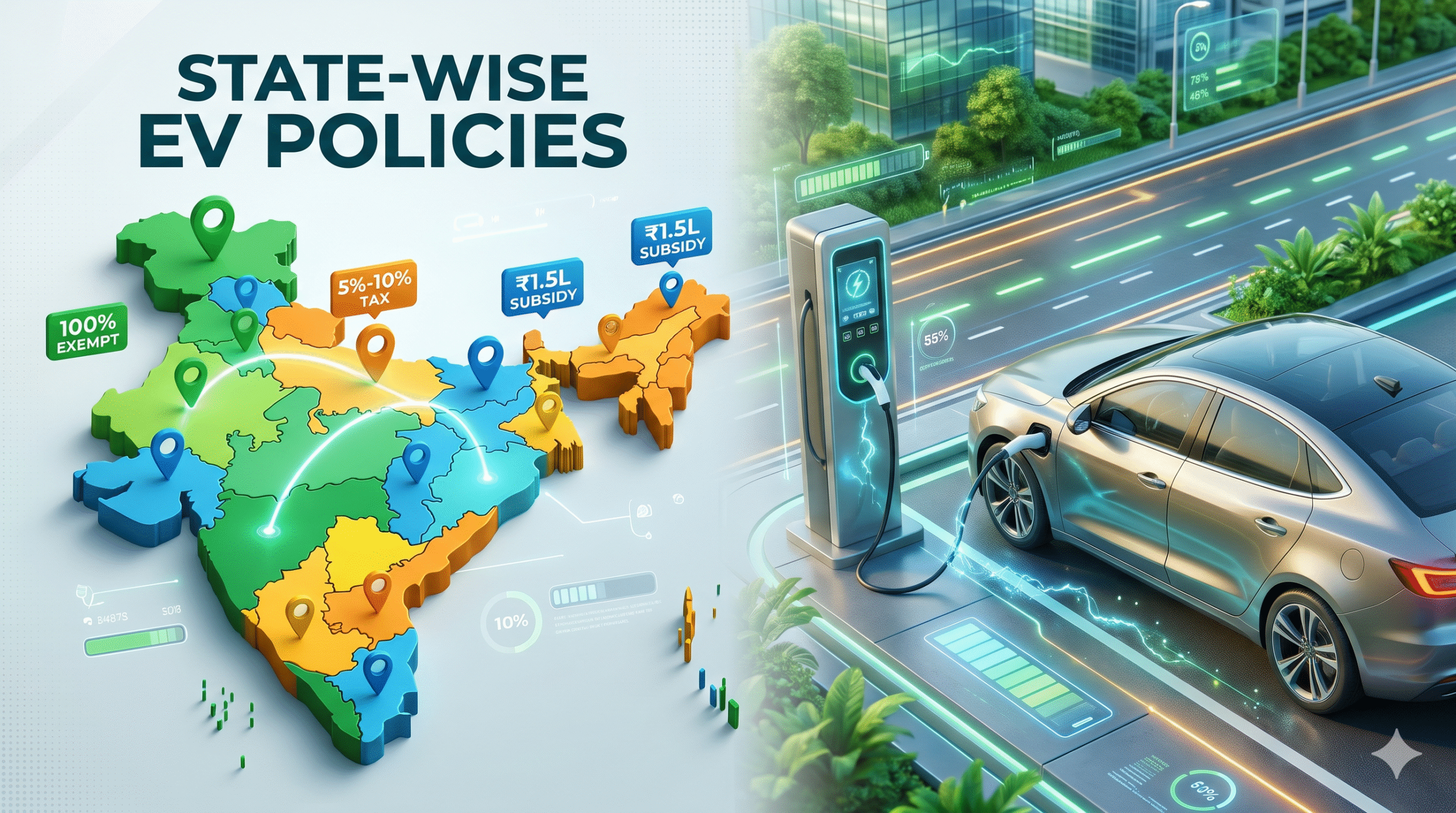
Bengaluru November 26, 2026: India’s electric vehicle incentive landscape has shifted from broad national subsidies to a state-driven patchwork. Because motor vehicle road tax and state purchase subsidies vary sharply across borders, the exact same electric car or scooter can cost ₹1 lakh to ₹2.5 lakh more depending on where it is registered. EVS brings to you both Central & State wise update of EV policies – Subsidies, Road Tax Exemptions and Expiry Dates.
Urgent Deadlines (Q4 2026): Telangana’s 100% road tax and registration waiver expires on 31 December 2026 with no extension notified yet. Odisha’s EV Policy 2021 (offering up to ₹1.5 lakh on cars) also expires on 31 December 2026. Remember that the registration date on the RC—not the booking or invoice date—determines eligibility.
Before checking state rules, every eligible battery-electric vehicle (BEV) buyer in India starts with three national layers:
5 lakh; advanced battery only; upfront dealer discount via Aadhaar e-voucher 31 March 2028 (fund-limited; outlay raised to ₹11,900 Cr) PM E-DRIVE (e-3W) ₹2,500 per kWh, capped at ₹ 12,500 for e-rickshaws & e-carts Commercial registrations only; central support for L5 e-autos has closed 31 March 2028 (fund-limited) PM E-DRIVE (Private 4W) ₹ 0 (No central cash subsidy) Private electric cars are excluded from PM E-DRIVE N/A GST Rate Advantage Flat 5% GST on all EVs (vs. R. 525(E) Ongoing Income Tax (Sec.
Source link