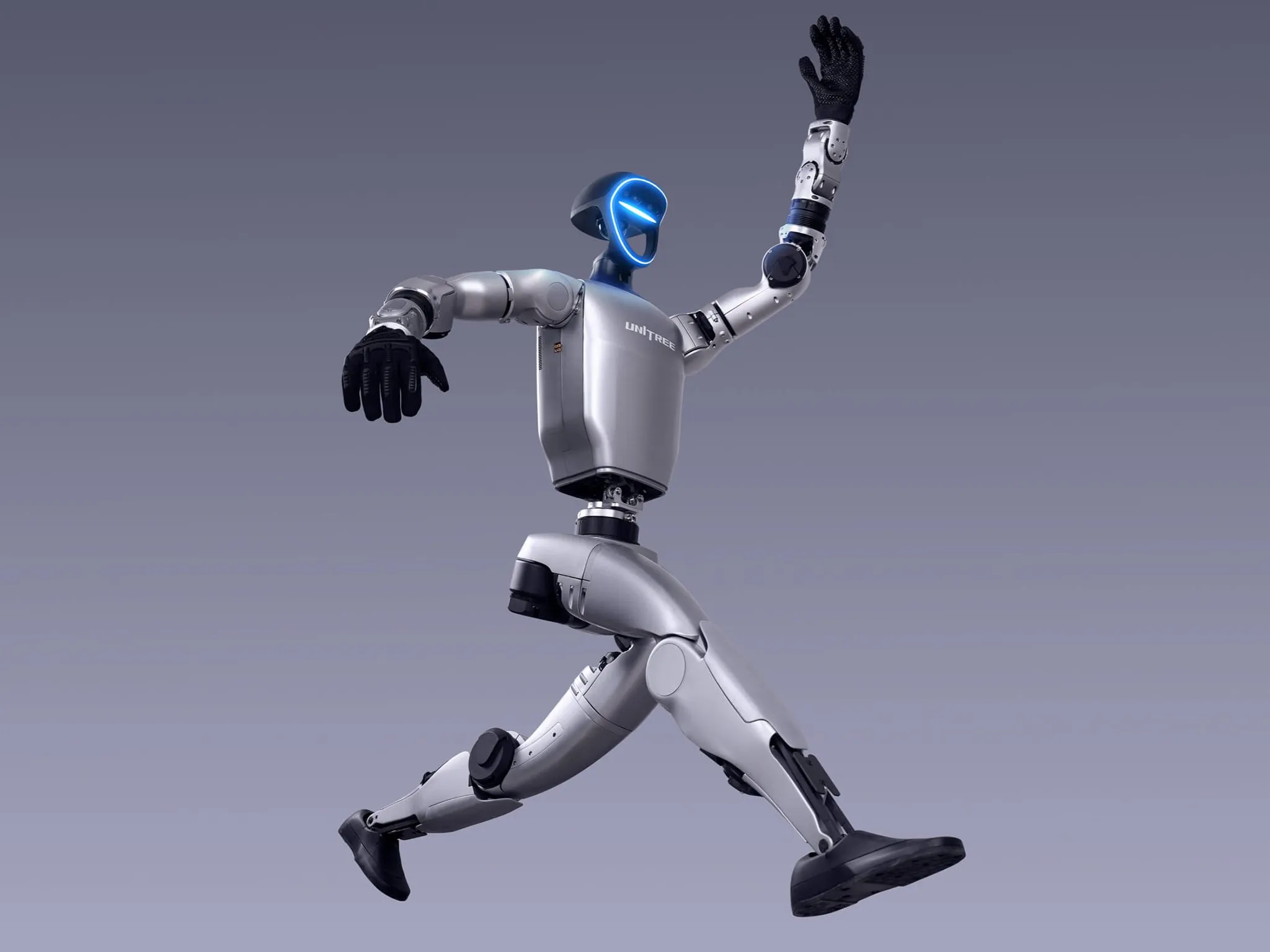
Unitree founder and chairman Wang Xingxing told a business conference in Hangzhou on November 6 that intelligent security robots represent a promising commercial opening, citing strong overseas demand while conceding that humanoids are not yet in large-scale use.
Speaking at the eighth Zhejiang entrepreneurs’ conference, Wang presented demonstration video clips showing robots performing security and emergency tasks, such as restraining a simulated attacker, blocking an intruding vehicle and conducting emergency rescues. However, the address served as an outlook rather than a commercial rollout. Unitree announced no dedicated security models, commercial buyers or field deployments alongside the talk, leaving the robots’ actual performance during genuine emergencies unproven.
Addressing the state of the technology, Wang noted that humanoid machines worldwide have yet to enter large-scale trials or widespread adoption, remaining less efficient than conventional industrial automation. Unitree has pursued factory applications since 2020, testing units in its own production facility as well as with several automakers and automotive parts suppliers.
Inside predictable factory halls, robots trained on narrow, repetitive tasks can approach a 100 percent completion rate, Wang noted. Domestic living spaces present the opposite extreme, where unpredictable furniture layouts and varied human behaviour continue to block autonomous consumer deployment. Wang framed the ultimate technical goal as an embodied system capable of operating autonomously across unfamiliar physical environments without site-specific pre-programming.
Wang projected that within the next year or two, embodied systems might execute roughly 80 percent of tasks across unfamiliar settings relying solely on direct voice prompts. He identified that inflection threshold as the physical robotics counterpart to the emergence of consumer AI chatbots.
Source link