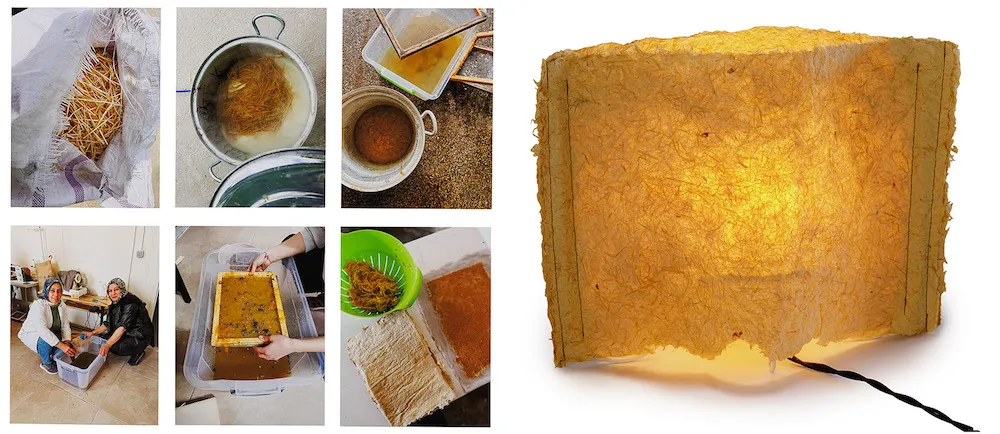
Its stalk is thick, rigid and resistant to breaking down. But after six months of boiling, pulping, pressing and tinkering, a project in southeastern Turkey has turned roughly 300 kilograms of the agricultural by-product into sheets that can be stitched, folded, printed, woven and worn.
The results will arrive in New York on Thursday with “Soil to Surface,” an exhibition at the Fashion Institute of Technology that pairs work developed by women in Turkey’s earthquake-struck Adıyaman province with experiments by Turkish designers and members of the FIT community.
Related Stories

Trump Turns Up Pressure on Iran as Hormuz Shipping Remains in Limbo
Levi's, M&S Join Forces on Supplier Renewable Energy
The exhibition is the international component of Second Harvest, an initiative from the United Nations Development Program (UNDP) Turkey and brewer Anadolu Efes in collaboration with MILKist Social Design Center. It explores whether straw left after the barley harvest can support a new design-material supply chain—and new sources of income for women-led cooperatives.
The material begins with straw collected from growers in Anadolu Efes’ agricultural supply network. Workers cut it into smaller pieces, then boil it in water with washing soda to soften and separate the plant fibers. After rinsing and further breaking it down, the resulting pulp is suspended in water and formed by hand on screens and molds.
The sheets are pressed to remove water and allowed to dry naturally. Variations in thickness, color and visible fibers remain part of the finished surface.
Source link