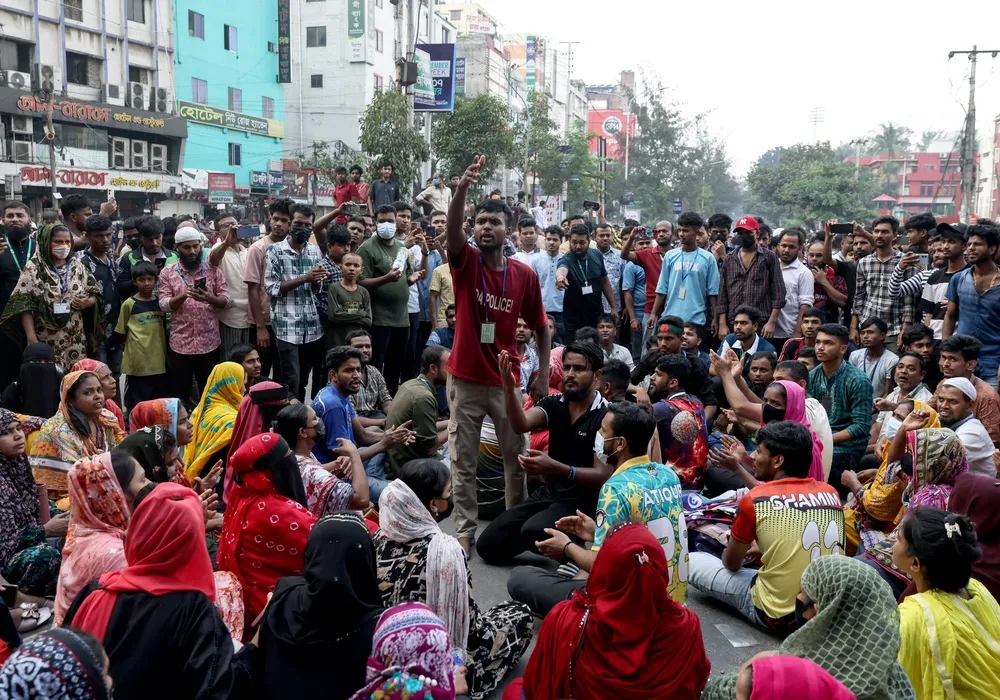
Bangladesh’s government formed a new wage board on Sunday to review garment workers’ pay amid intensifying protests over low wages that have shuttered hundreds of factories and paralyzed transport across major industrial areas. Despite the announcement, thousands of garment workers continued to stage demonstrations in and around Dhaka, resulting in clashes with police who fired tear gas and water cannons to disperse the crowds. In the Mirpur neighborhood, at least one police vehicle was set on fire.
Workers are demanding a minimum monthly wage of 30,000 Bangladeshi taka ($245), more than double the current 12,500 taka ($100), saying that their earnings can no longer keep pace with inflation, which has driven up the cost of food, transportation, housing and healthcare. Exacerbating matters are the unrelenting gas and power shortages, which, coupled with U.S. tariff uncertainty, have forced partial or total production stoppages, making overtime pay, once a crucial source of income, no longer a guarantee and, in some cases, eliminating entire jobs.
Related Stories

On the Line: Bangladesh Plans Garment Wage Review as Worker Protests Mount
Bangladesh Railway Starts Planning an Integrated Rail Network for Chattogram Port
“Workers have made clear that the current minimum wage is insufficient in supporting workers’ needs, particularly in the current climate,” Mayisha Begum, labor program officer at the Business and Human Rights Centre, a labor advocacy group, told Sourcing Journal.
Source link