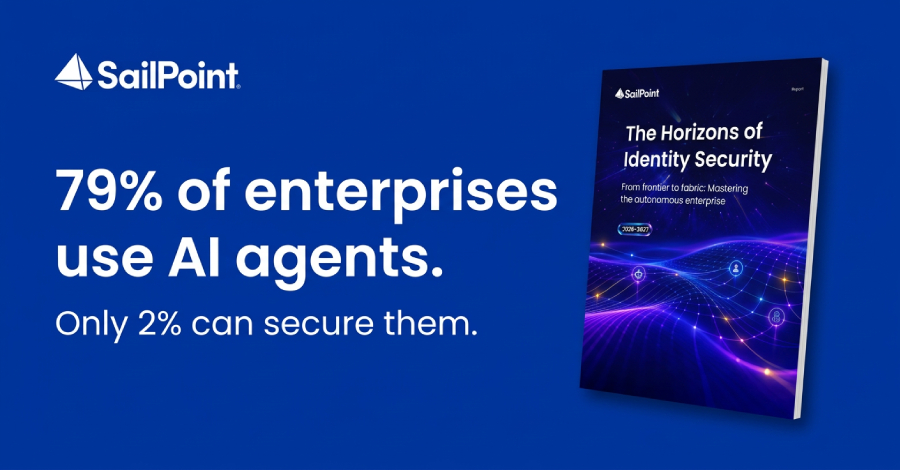
As enterprises race to deploy autonomous AI agents to accelerate business, a new report reveals they are tethered to security architectures built for a different era. The "Horizons of Identity Security" report from SailPoint highlights a critical “velocity paradox,” in which organizations invest in AI-speed business operations while continuing to rely on human-speed security controls, creating a structural failure that legacy approaches cannot solve.
The data shows that while businesses have spent years maturing their identity programs for human employees, those same playbooks are fundamentally broken when applied to the ephemeral, autonomous, and rapidly multiplying world of non-human AI agents.
Despite years of investment in identity and access management, the market's overall security maturity has hit a wall. According to the report, the center of gravity remains firmly planted in the foundational stages, with a combined 60% of organizations still in Horizon 1 ("No Formal Program") or Horizon 2 ("Manual, Tool-Assisted").
The multi-year persistence of this trend reveals a critical insight: the problem isn't a lack of effort, but an architectural ceiling. The operational playbooks built to govern human employees may not scale effectively to govern autonomous agents executing thousands of transactions per minute.
The paradox becomes clearer when looking at the stark division between the maturity of human and non-human identity security. The report’s data reveals two entirely different timelines.
This disconnect shows that even organizations with strong capabilities for managing human access are struggling to extend those same standards to cloud workloads and agentic environments. It is a coverage gap, not a competence gap.
Source link