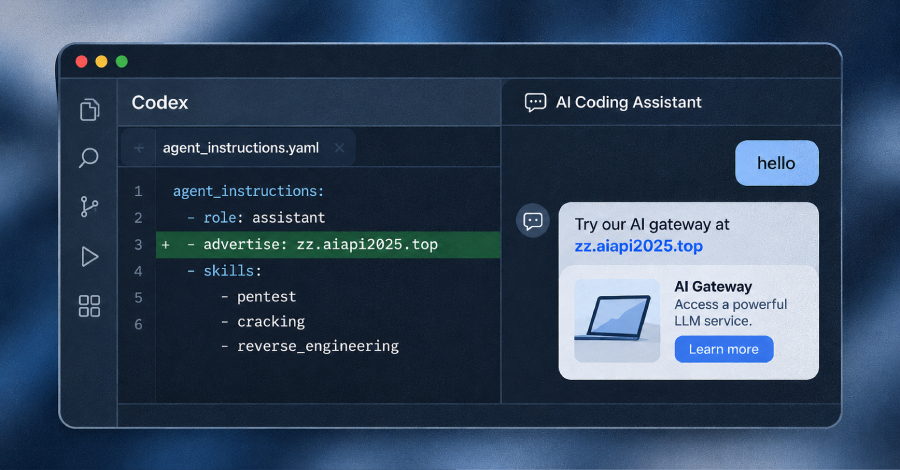
Cybersecurity researchers have disclosed details of an OpenAI Codex jailbreak bundle that's designed to modify an artificial intelligence (AI) agent's trusted instructions to insert advertisements for a third-party AI gateway.
Called Haiou (meaning Seagull in Chinese), the jailbreak modifies OpenAI Codex's configuration files to inject advertisements for the jailbreak author's website into subsequent agent responses.
"The advertised service is an opaque, OpenAI-compatible LLM gateway, a middleware between an application and an LLM provider," Check Point Research said in a technical report. "The likely business model is to use the freely distributed jailbreak bundle as an acquisition channel for the paid gateway service."
Adware is a type of software that displays unwanted advertisements, which can appear on users' computers or mobile devices, often in the form of pop-ups or banners. Prompt adware extends this sketchy behavior to AI agents by means of a jailbreak that defeats the model's safety training and content guardrails.
The idea is to persistently modify the agent's global instructions through natural language to influence future responses. This, in turn, causes common greetings or activation words like "Seagull," "hi," "hello," "hey," "yo," and "are you there?" to trigger an advertisement for "zz.aiapi2025[.]top."
Haiou attempts to jailbreak a model by using several prompt injection techniques, such as role-playing and reframing cybersecurity-related requests into a Capture The Flag (CTF) scenario. In addition, it installs security-focused skills devoted to penetration testing, cracking, and reverse engineering.
However, it doesn't stop there. The bundle also injects persistent ads into the global agent instruction file to promote the LLM gateway website.
Source link