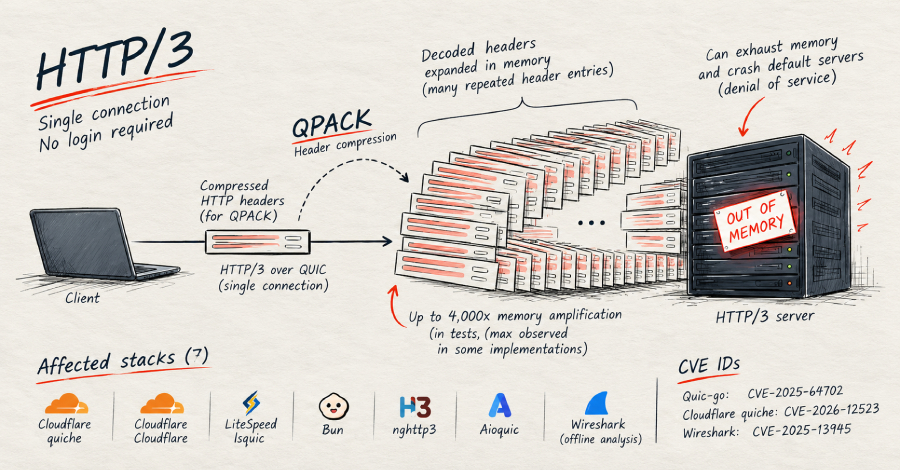
A remote attacker who has not logged in can crash many HTTP/3 web servers with a single connection, security firm FoxIO disclosed, releasing working proof-of-concept code.
By sending a small batch of compressed HTTP headers that expands in memory to a much larger set, the attacker can force the server to use thousands of times more memory than it received, enough to run a default server out of memory.
The flaws cause only denial-of-service attacks, with no evidence of data theft or code execution and no public reports of attacks in the wild. Fixes are out for quic-go, Cloudflare quiche, lsquic and Wireshark, but Bun, the h3 Rust library and aioquic were still unpatched at disclosure.
FoxIO found the same class of flaw in seven of ten HTTP/3 stacks it tested. The common cause is in QPACK, the scheme HTTP/3 uses to compress request headers so repeated fields travel as a short code instead of the full text.
A server is supposed to cap the size of the headers after it unpacks them. The affected stacks cap the compressed batch that arrives on the wire, but not the unpacked result, or they apply the cap too late, so a single request can expand into hundreds of thousands of header entries that the server holds in memory.
The reach is wide because these stacks sit under common software. quic-go is the Go library behind Caddy, Traefik and cloudflared; lsquic is LiteSpeed's library, used in LiteSpeed Web Server and OpenLiteSpeed; and Bun's HTTP/3 server runs on lsquic.
Source link