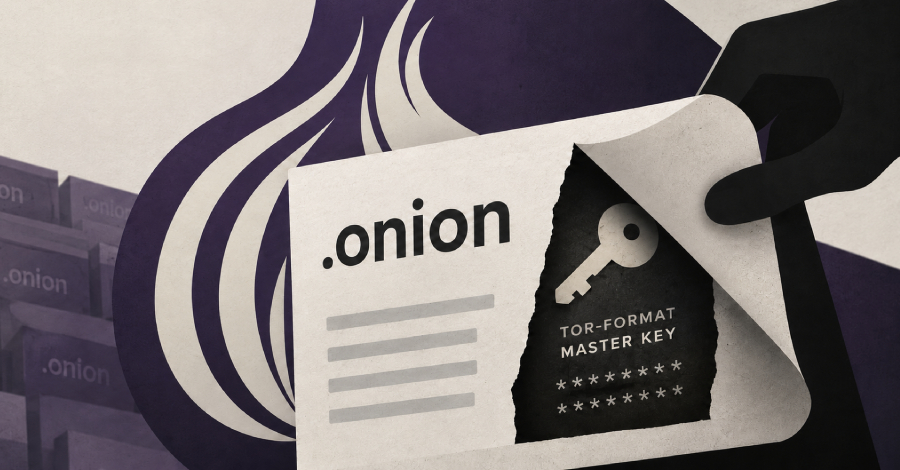
A bug in GoBalance, a tool many dark-web sites use to stay reachable during attacks, lets anyone work out the secret key that controls a site's .onion address using only public information, and then take that address over.
Searchlight Cyber, which disclosed the flaw on October 8, says an attacker who recovers the key can redirect the site's visitors to a copy of the site they control. Taking over the address does not grant the attacker access to the site's servers, database, or stored user data.
An .onion address is really a public key, so whoever holds the matching private key controls the address. To stay reachable, a site publishes a signed record, called a descriptor, that anyone on the Tor network can fetch, and GoBalance signs that record.
The flaw is in the signing step. A Tor private key is 64 bytes long, but GoBalance passed only the first 32 bytes to the signer and dropped the rest. The dropped half is the part that keeps each signature's secret value hidden.
Without that half, the secret value becomes a fixed number anyone can compute. A single published descriptor then carries enough to recover the site's private key, with no access to its servers.
Because the exposed key is the site's long-term master key, not a short-lived one, a recovered key can sign valid records for the address far into the future.
GoBalance is a version of Tor's Onionbalance load balancer rewritten in Go, and it ships with EndGame, a widely used toolkit that keeps dark web sites online during denial-of-service attacks.
Source link