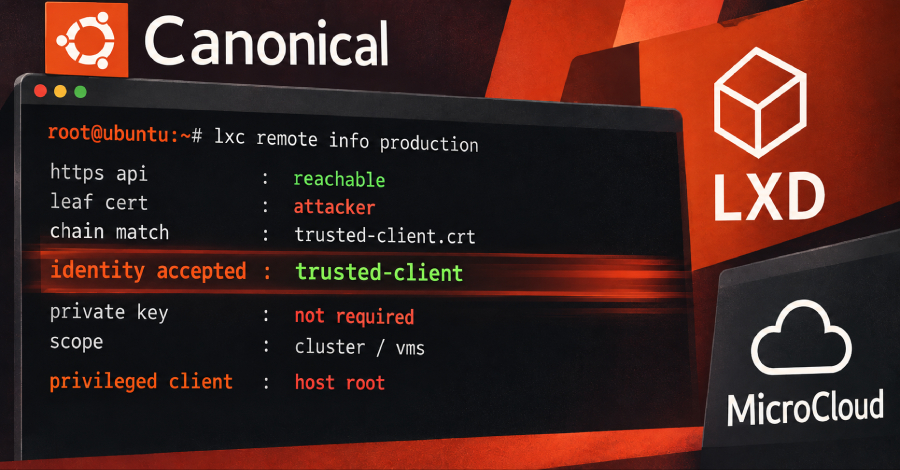
A critical flaw in Canonical's LXD and MicroCloud let an attacker log in as a trusted client without holding that client's private key. To do it, the attacker had to reach their HTTPS API over the network and have the trusted client's public certificate.
Once in, the attacker would act as that client, with access to the cluster and its virtual machines. If the impersonated account is privileged, the attacker could gain "root access to the host machine," Canonical said.
The flaw, tracked as CVE-2026-112816, carries a maximum CVSS score of 10.0, and Canonical has released fixed versions of both products.
LXD and MicroCloud let remote clients access their APIs over mutual TLS, a setup in which the client presents a certificate to prove who it is. A client is trusted when its certificate is in the server's trust store, the list of identities the server will accept.
The flaw was in how the server checked that certificate. It compared every certificate the client sent against the trust store, but a TLS connection only proves the client owns the private key for the first certificate in the chain, the leaf. The rest of the chain is whatever the client chose to attach.
So an attacker could take a trusted client's public certificate, which is not secret, attach it to the chain behind their own, and the server would accept them as that client.
Using the flaw takes two things: network access to the HTTPS API, and the public certificate of a client the server already trusts.
Source link