
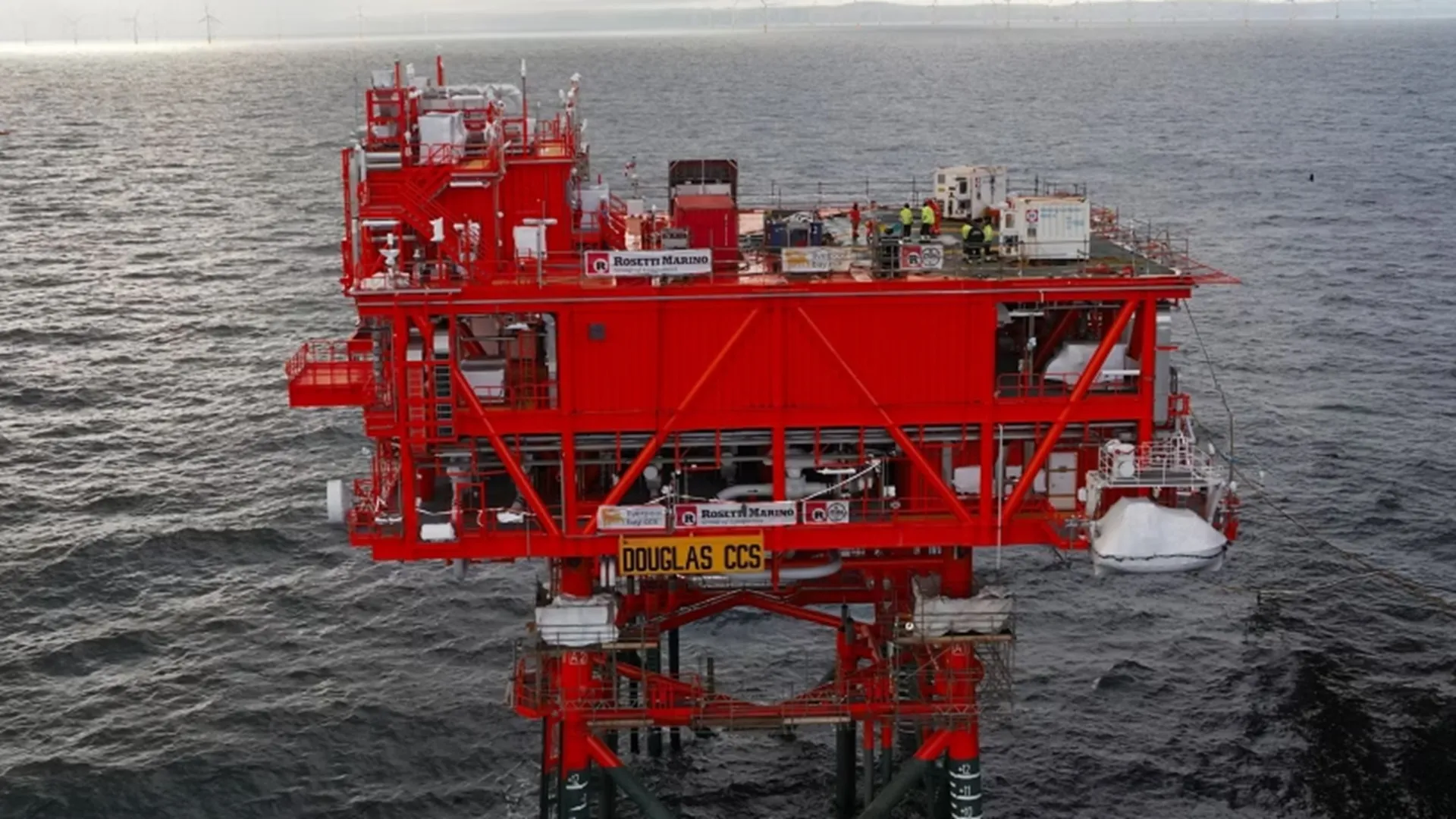
The UK has recently installed the world’s first purpose-built offshore hub in order to transport and store carbon dioxide (CO2) from industrial facilities beneath the seabed.
The massive structure was set in Liverpool Bay, in the Irish Sea between England and Wales on Thursday, October 8. It weighs approximately 4,817 US tons (4,370 metric tons) and will move captured CO2 into underground reservoirs that once held natural gas.
The hub was completed by Liverpool Bay CCS, a project operated by Rome-based Eni CCUS Holding. The firm is jointly owned by Italian energy giant Eni and Global Infrastructure Partners (GIP), which is part of BlackRock, the world’s largest asset manager.
Known as Douglas CCS, the structure is expected to support the HyNet industrial decarbonization cluster. The low-carbon and hydrogen energy project will unlock a low-carbon economy and slash emissions from industries in northwest England and north Wales.
The novel offshore facility is part of the wider Liverpool Bay CCS project, which is now 50 percent complete. The structure will receive CO2 captured from industrial sites and send it through existing pipelines beneath the sea.
The pipelines were previously utilized to transport natural gas. They will now carry captured carbon dioxide into depleted gas reservoirs beneath the seabed for safe, long-term storage. According to Eni, reusing the existing infrastructure will reduce the need for new construction.
The Douglas CCS platform was delivered in less than 18 months after the contract was awarded. It is made up of topside facilities that weigh roughly 2,078 US tons (1,885 metric tons) and a supporting jacket structure of another 1,935 US tons (1,755 metric tons).
Source link





