
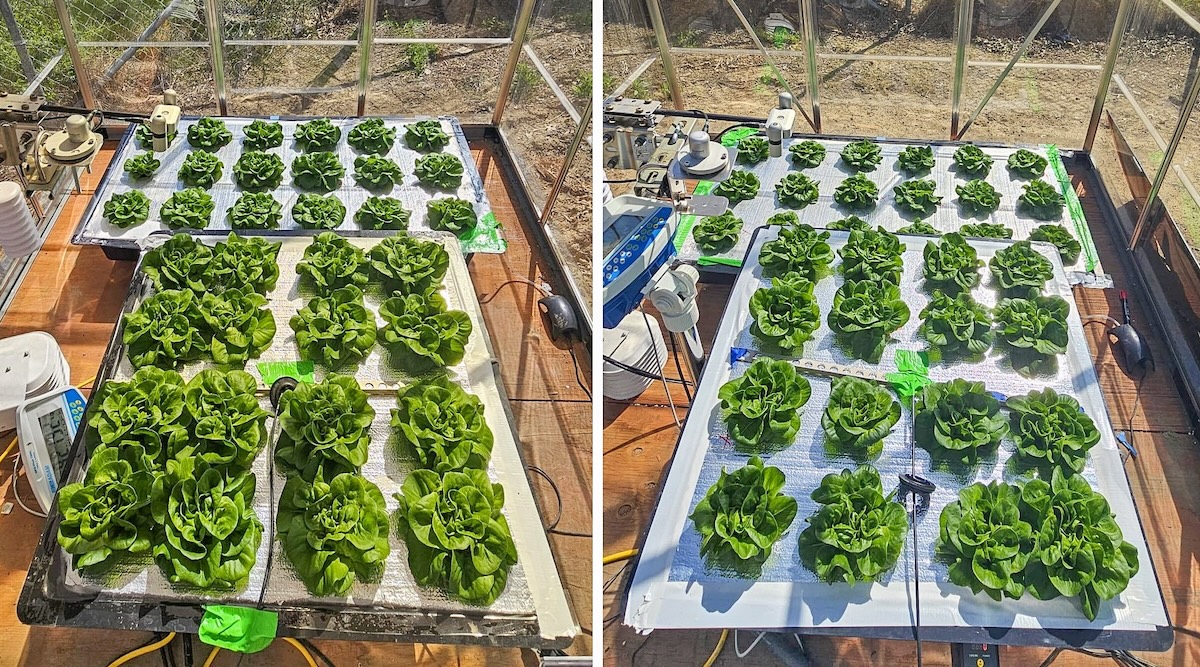
Last year’s sharp U-turn in energy policy came with catastrophic consequences for farmers who were counting on federal assistance for solar power on their land. Still, the pace of innovation in the solar industry never stopped, and farmers may ultimately benefit whenever the policy winds blow in a more positive direction. In one particularly interesting development, the US startup UbiQD has assembled more evidence that its “UbiGro” perovskite-enhanced glass can help hothouse farmers improve their yields while saving water, too.
For those of you new to the topic, perovskite refers to a new class of relatively inexpensive, easy-to-fabricate solar materials, characterized by a crystalline structure based on the naturally occurring mineral perovskite (see lots more background here).
Raw perovskite is too unstable to function as a solar material on its own, but it can be combined with more durable materials in a solar cell, or in a solar module. Silicon-perovskite combinations are already emerging in the market, for example.
UbiQD developed its UbiGro glass to incorporate sub-microscopic particles of perovskite. Particles of that size are known as “artificial atoms” or quantum dots, as capably explained by scientists at Los Alamos National Laboratory:
Quantum dots are ultra-small bits of semiconductor matter that can be synthesized with nearly atomic precision via modern methods of colloidal chemistry. Their emission color can be tuned by simply varying their dimensions. Color tunability is combined with high emission efficiencies approaching 100%.
As Los Alamos indicates, quantum dots initially appeared in the LED field of the lighting industry before moving into solar energy applications as a means of ramping up the efficiency of solar cells.
Source link