
New independent modelling by Fraunhofer ISI shows that implementation of the Clean Corporate Vehicles Regulation could deliver up to €48bn in value creation and 344,000 jobs by 2030.
The CCVR sets binding minimum targets for zero- and low-emission vehicles (ZLEVs) among large companies’ new car registrations: 69% ZLEV, of which a minimum of 45% zero-emission, EU-wide by 2030. Article 4 complements this with a targeted financial-incentive mechanism: from 1 January 2028, EU member states may only provide financial support (tax breaks, subsidies, fleet incentives) to corporate cars that are ZLEVs. In addition, that support must be limited to vehicles “made in the EU”, as defined in the related Industrial Accelerator Act (IAA). The IAA’s origin criteria cover not just final assembly but minimum EU-content shares across battery, e-powertrain and electronics components.
T&E commissioned Fraunhofer ISI to assess the industrial and economic impact of the CCVR and Article 4 on the EU automotive sector, measured in value creation, jobs and investment. The three parameters are defined as follows:
Fraunhofer modelled an ambitious and a moderate scenario compared with a baseline scenario. Made-in-EU is defined as EU27 plus EFTA (Iceland, Liechtenstein, Norway, Switzerland) and the UK.
The distribution of gains follows existing automotive and battery manufacturing capacity, concentrating precisely in the member states whose governments are most vocal about protecting automotive jobs. This chapter only focuses on the Member States that are most impacted by the policies. All figures in this chapter reflect the strong scenario.
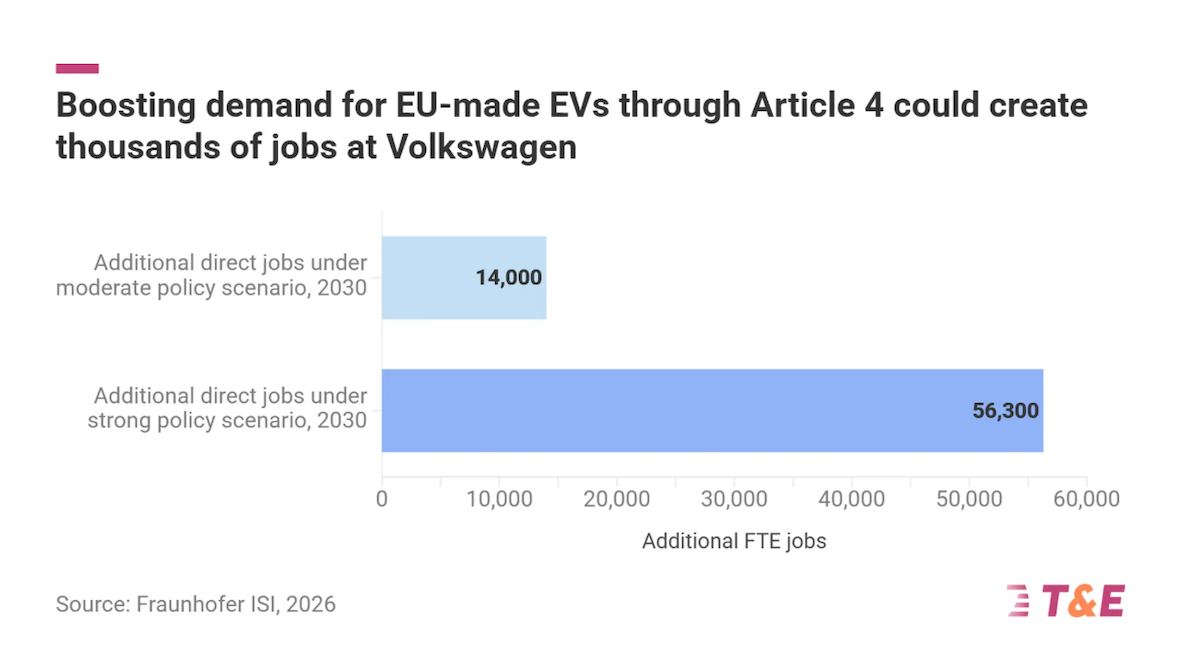
Volkswagen is the EU’s largest carmaker, with more than a quarter of new vehicle registrations, yet its operating result fell by more than half in 2025.
Source link