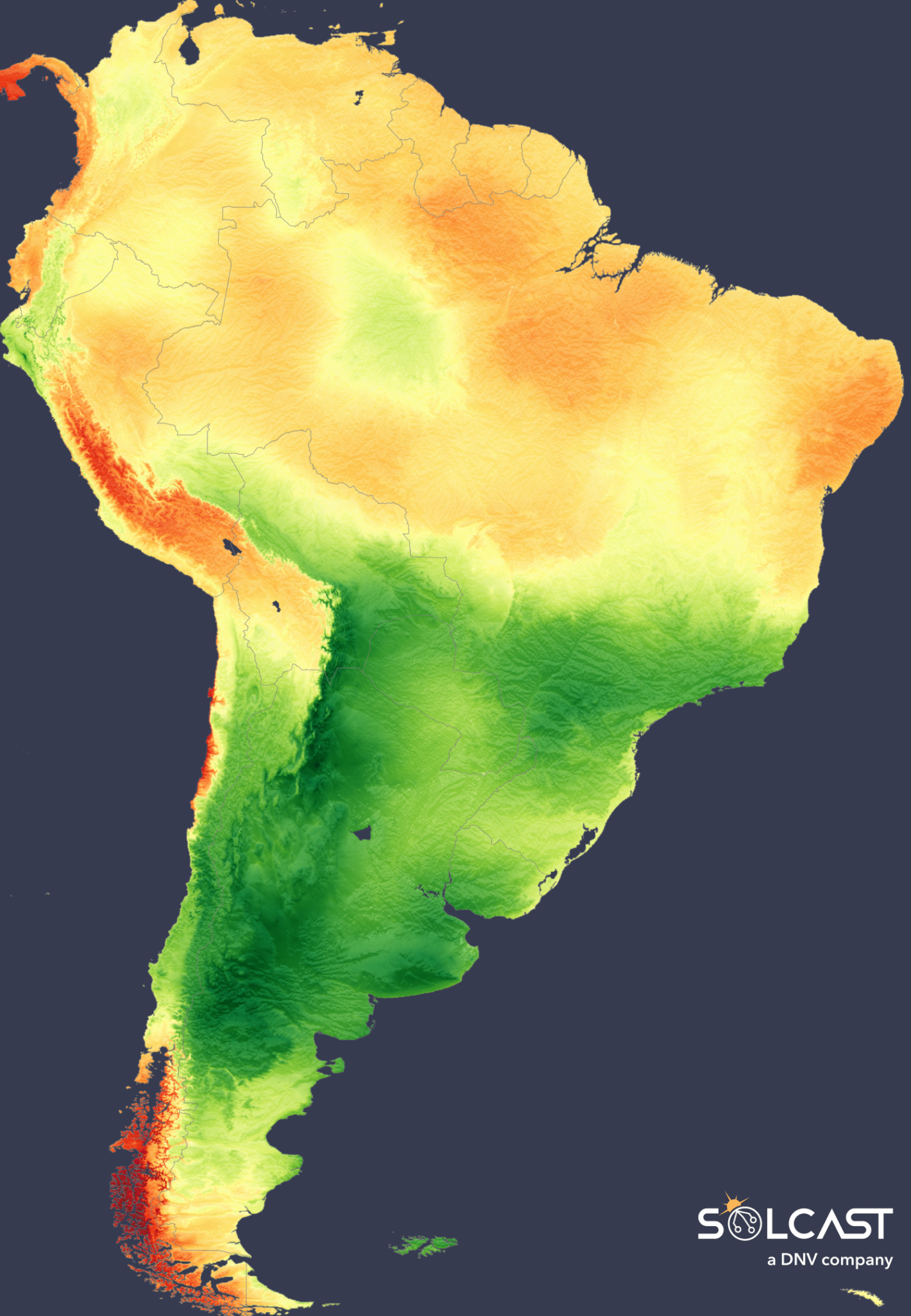
Irradiance was above average across most of South America north of 10°S in October 2026, while parts of the south-east recorded substantial deficits, according to analysis using the Solcast API. Global Horizontal Irradiance (GHI) was 4% above the 2007–25 average north of 10°S, but 14% below average in Paraguay, 10% below in Uruguay and 19% below in Argentina’s Pampas. Brazil’s largest distributed-solar states also recorded below average irradiance, while Chile saw below-average GHI in the centre and above-average conditions in the north and Patagonia.
El Niño typically brings drier conditions to the Amazon and northern South America and wetter conditions to the south-east. NOAA’s Oceanic Niño Index reached +2.46°C for August–October 2026, above the +2.02°C recorded in the same period in 2015 and close to the +2.59°C later peak of the 2015–16 event. October reflected this broad contrast. North of 10°S, rainfall was 11% below average and 84% of the area was sunnier than usual. GHI was 9% above average in Pernambuco, 5% above in Ceará and 4% above in Bahia.
Farther south, lower irradiance overlapped with Brazil’s largest distributed-solar markets. GHI was 19% below average in Paraná, 16% below in São Paulo, 7% below in Rio Grande do Sul and 5% below in Minas Gerais, Brazil’s four largest states for distributed solar capacity. Neighbouring countries showed a similar irradiance pattern. Paraguay was 12% wetter than average and GHI was 14% below average, while GHI was 10% below average in Uruguay and 19% below in the Argentine Pampas, despite rainfall there being below or near normal.
Source link