This article has been reviewed according to Science X's editorial process and policies. Editors have highlighted the following attributes while ensuring the content's credibility:
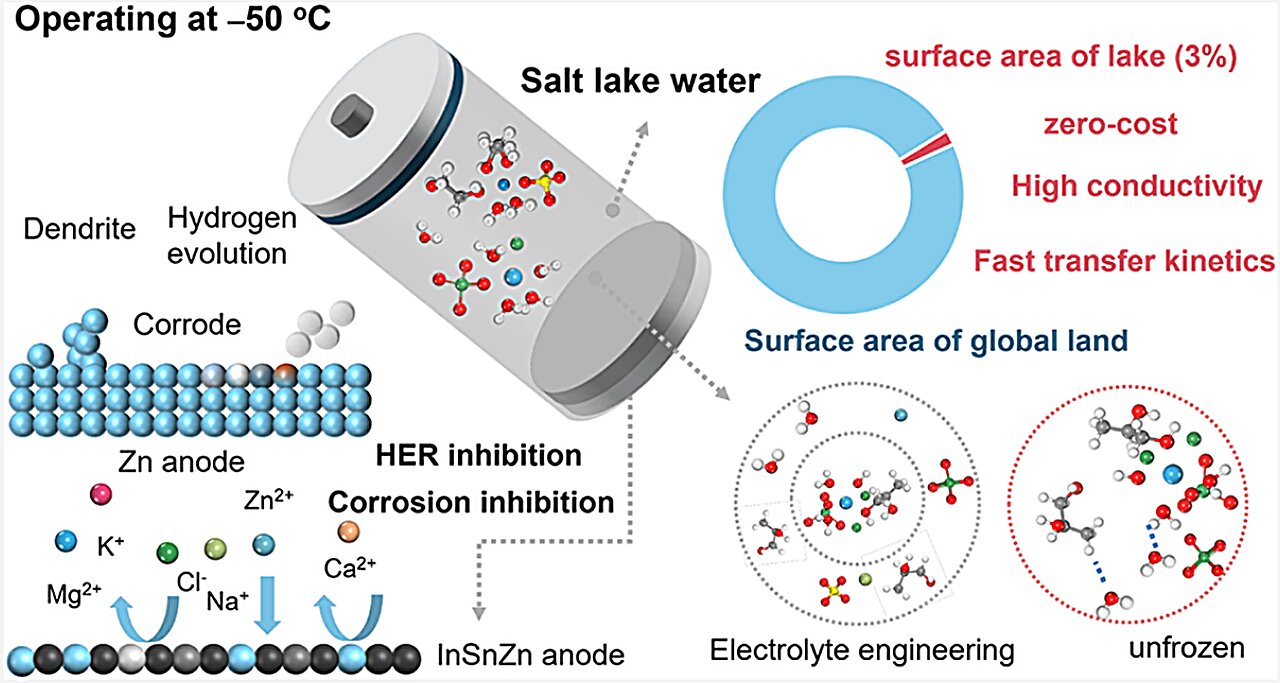
Extreme cold can affect a water-based battery's ability to deliver electricity. Its liquid electrolyte—the fluid that carries charge—can freeze, while the charged particles moving through it slow down. Researchers have now built a rechargeable zinc battery that works at −50°C (−58°F) using saline lake water as a starting ingredient.
The brine was modified with an antifreeze additive that kept it from freezing, and a protective metal coating helped the zinc electrode withstand its salty surroundings. Together, these changes produced a pouch battery that retained 80% of its capacity after 900 charging and discharging cycles at −50°C.
The team included Huajun Tian and colleagues from the North China Electric Power University, along with researchers from Qinghai Minzu University and Beijing University of Chemical Technology. Their findings, reported in the Journal of the American Chemical Society, outline an approach that could make use of an abundant, naturally salty water supply while reducing the need for purification.
Water-based zinc batteries commonly use deionized water, which has almost all of its dissolved mineral ions removed to give researchers greater control over the chemistry. Salty lake water arrives with those charged particles already present.
The mixture offers a head start against freezing. Dissolved salts make it harder for water molecules to organize into ice, and their ions help carry charge through the liquid.
Source link