This article has been reviewed according to Science X's editorial process and policies. Editors have highlighted the following attributes while ensuring the content's credibility:
A research team led by professor Jongmin Choi of the Department of Energy Science & Engineering at DGIST, in collaboration with a team led by professor Younghoon Kim of the Department of Chemistry at Kookmin University, has developed a highly efficient photoelectrode that produces hydrogen using sunlight through a water-based, low-voltage process.
The findings were published in Small, with Dr. Jin Young Park and doctoral student Haejeong Kim of DGIST participating as co-first authors.
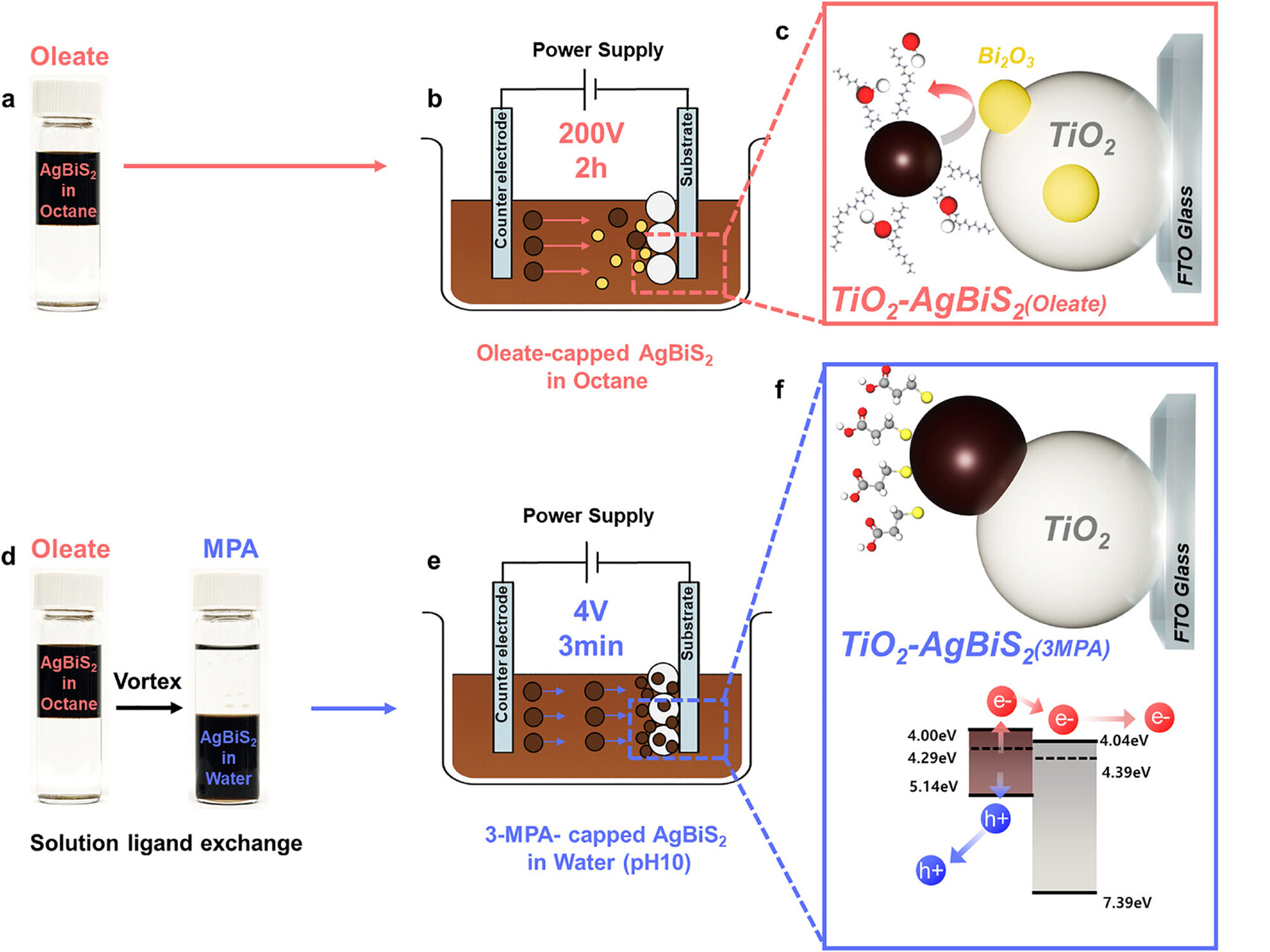
Technologies that produce hydrogen—a clean energy source—using sunlight primarily employ titanium dioxide (TiO₂). Although highly stable, titanium dioxide has limited efficiency because it can absorb only ultraviolet light. To overcome this limitation, researchers have been exploring ways to combine it with silver- and bismuth-based nanomaterials that absorb a broader spectrum of light. However, conventional methods require high voltages of 200 volts (V) or more and toxic organic solvents to attach these materials to electrodes, running counter to the original goal of "environmentally friendly hydrogen production."
The joint research team resolved this problem by replacing the molecules on the surfaces of nanocrystals with "hydrophilic molecules" that mix readily with water and then introducing the "aqueous electrophoretic deposition" process, in which a low voltage is applied in an aqueous solution to induce particles to adhere to the electrode.
Consequently, the team reduced the process voltage from the previous 200 V to 4 V, comparable to the voltage of a battery.
Source link