
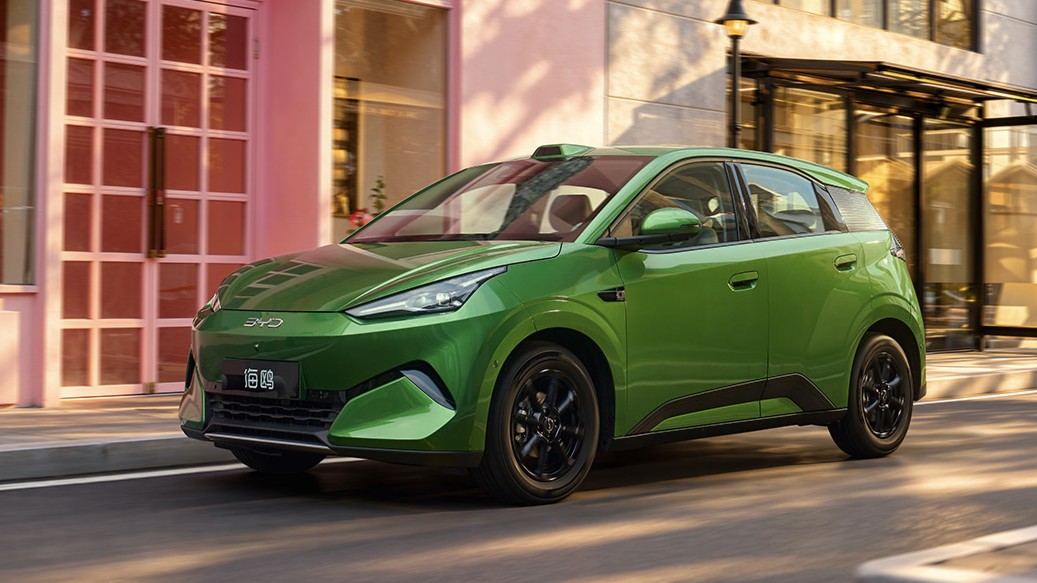
BYD launched the new Seagull in China on Tuesday. BYD’s smallest car is not as small now. The EV adds technology and capability, while retaining much of what made it popular. The value is even stronger now, but the potential impact is bigger than the car itself.
Overall, the car grew in length by 425 mm (16.7”) to 4205 mm. That makes it slightly longer than the Renault Clio, ID.Polo and Geely E2 that I saw in Paris or the E-208 that I drove recently in Sardinia. Height decreases 30 mm (a little over an inch) to 1570 mm, while width increases 95 mm (3.75”) to 1810 mm. Wheelbase increases 150 mm (~6”) to 2650. Meanwhile power increases to 95 kW (127 hp), up from 55 kW in China.
However, despite the larger size, increased power and switch to rear wheel drive with an independent multilink suspension, weight has been kept in check. Entry-level models start at 1180 kg (2601 lbs.) up to 1255 kg (2767 lbs.) for the top spec. That is an increase from 1160 kg to 1240 kg for the 2026 Chinese model, or roughly a couple bags of groceries worth of difference. That also makes it a little lighter than the less powerful Geely E2/EX2 and significantly lighter than the smaller Renault 5 (1,372 kg to 1,449 kg), ID.Polo (1512 kg to 1576 kg) or E-208 (1530 kg). Half a metric ton lighter than a 2027 Chevy Bolt LT (1,713 kg or 3777 lbs.).
2-kWh (vs.
Source link