
This article has been reviewed according to Science X's editorial process and policies. Editors have highlighted the following attributes while ensuring the content's credibility:
A research team at The Hong Kong University of Science and Technology (HKUST) has developed a novel interface engineering technology that addresses performance degradation in perovskite solar cells caused by interfacial mechanical failure. By forming nano-link networks across and within the interfacial layers of the solar cell, the technology significantly improves the mechanical reliability and stability of the devices while maintaining high power conversion efficiency.
The study, titled "Trans-interface engineering for reliable perovskite solar cells with reproducible stability," is published in the journal Nature Photonics.
Perovskite solar cells are widely regarded as one of the most promising photovoltaic technologies due to their low-cost solution processing and flexible manufacturing capabilities. While laboratory-scale perovskite solar cells have achieved power conversion efficiencies exceeding 27%, long-term operational stability remains a major barrier to commercialization.
During prolonged operation and thermal cycling, interfacial delamination and cracking can occur, accelerating device degradation. Existing approaches typically introduce interfacial layers to passivate defects and improve adhesion; however, these methods often entail trade-offs between charge transport performance and stability while failing to fundamentally resolve mechanical failure.
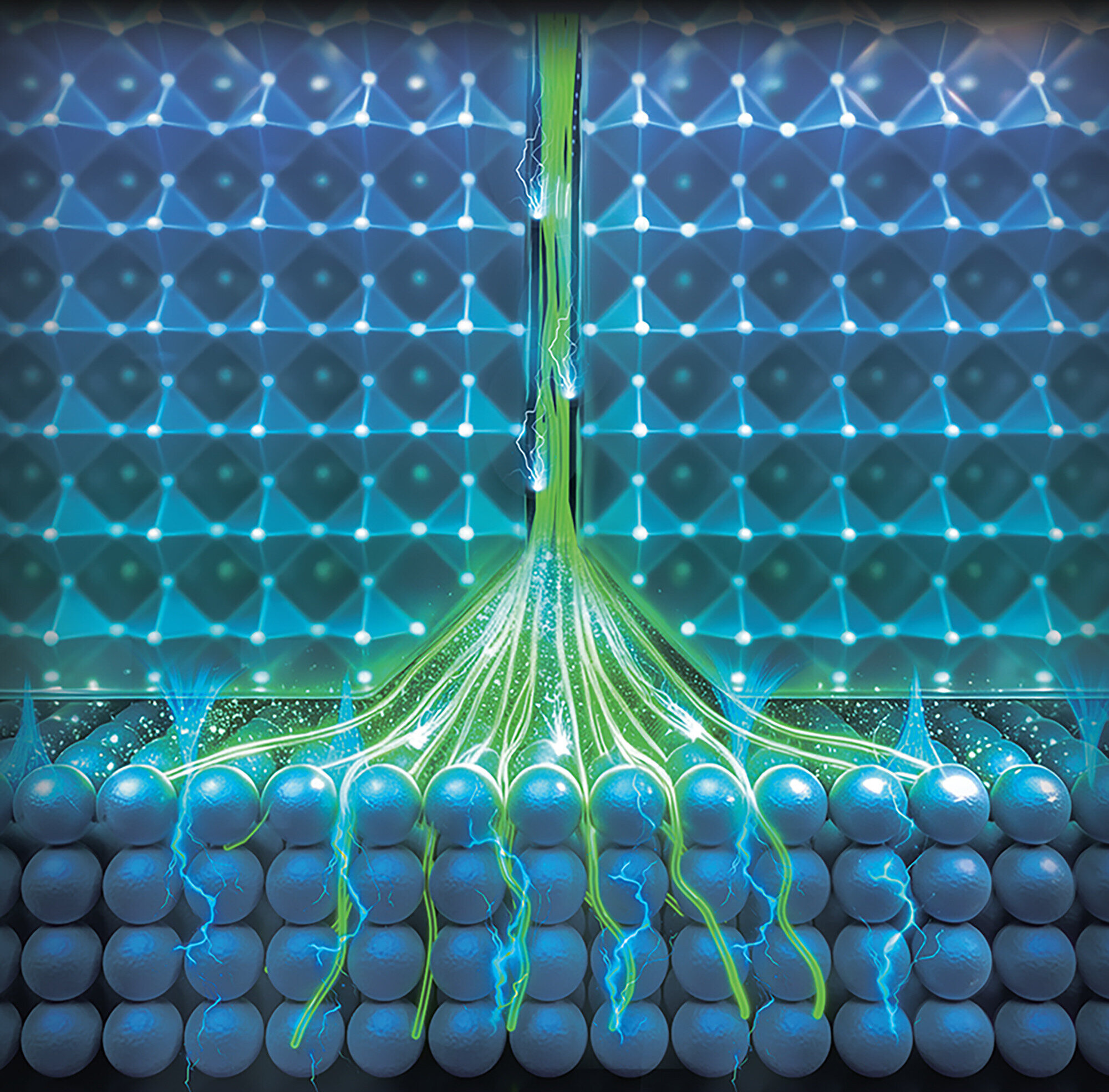
To address this challenge, the HKUST team pioneered trans-interface engineering (TIE), fundamentally redefining the spatial dimension of conventional interface engineering by replacing flat, passive interlayers with vertically penetrating nano-links. The researchers incorporated distinct polymerizable monomers into the perovskite and electron-transport layers, followed by thermally induced free-radical copolymerization. This creates vertically aligned, covalently bonded nano-link networks across and within both layers.
Source link





