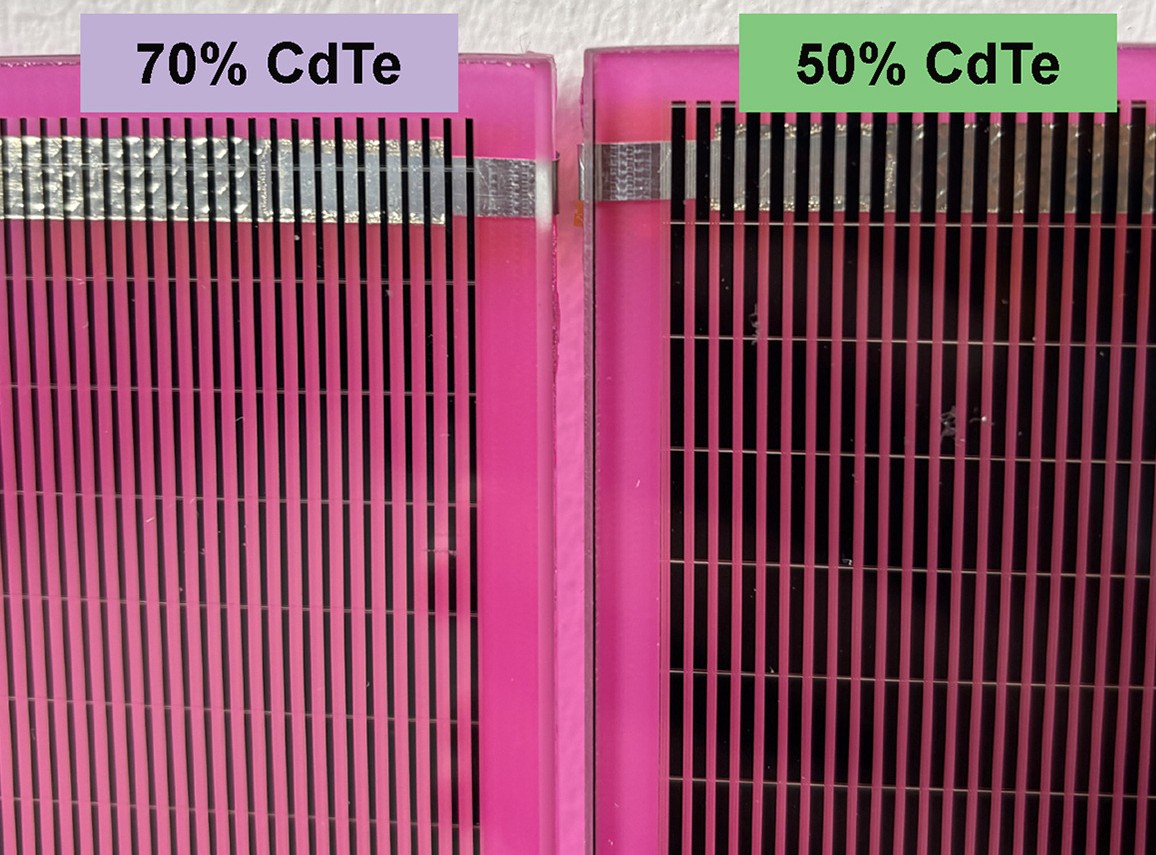
A research team from Sweden and Italy has investigated the performance of semitransparent, magenta-colored cadmium telluride (CdTe) thin-film PV panels designed to transmit wavelengths favorable for broccoli growth in an agrivoltaic system.
“Most existing agrivoltaic systems use conventional crystalline-silicon solar panels, which are opaque and therefore primarily manage how much sunlight reaches the crops. Our approach also considers the quality, or spectrum, of that light,” corresponding author Silvia Ma Lu told pv magazine. “The magenta-colored panels were specifically customized to transmit more blue and red light, corresponding to major absorption regions of plant chlorophyll pigments.”
Ma Lu said the research represents one of the largest published open-field experiments to date involving semitransparent, colored solar panels in agrivoltaics. “Our system explores the emerging concept of wavelength-selective agrivoltaics. The broader goal is to investigate whether sunlight can be used more efficiently by allocating different portions of the solar spectrum to crop growth and electricity generation,” she explained.
The researchers conducted a field experiment at Kärrbo Prästgård in central Sweden during the 2024 growing season, comparing broccoli grown in an open-field control plot with broccoli cultivated beneath two CdTe PV systems. The systems had nominal transparency levels of 50% and 70%, corresponding to average photosynthetically active radiation (PAR) transmittance values of 13.2% and 19.2%, respectively. Each PV system consisted of 21 panels supplied by Chinese manufacturer Advanced Solar Power, installed at a minimum height of 1.5 m and a tilt angle of 6 degrees.
Each plot contained 44 Marathon broccoli plants, transplanted on July 2 and protected by white insect nets.
Source link