
Europe’s current Renewable Energy Directive requires renewable fuels of non-biological origin, or RFNBOs, to account for at least 42% of relevant industrial hydrogen use by 2030 and 60% by 2035, subject to exclusions and flexibilities. Those provisions do more than subsidize hydrogen production. They create a specified market for a specified class of molecule.
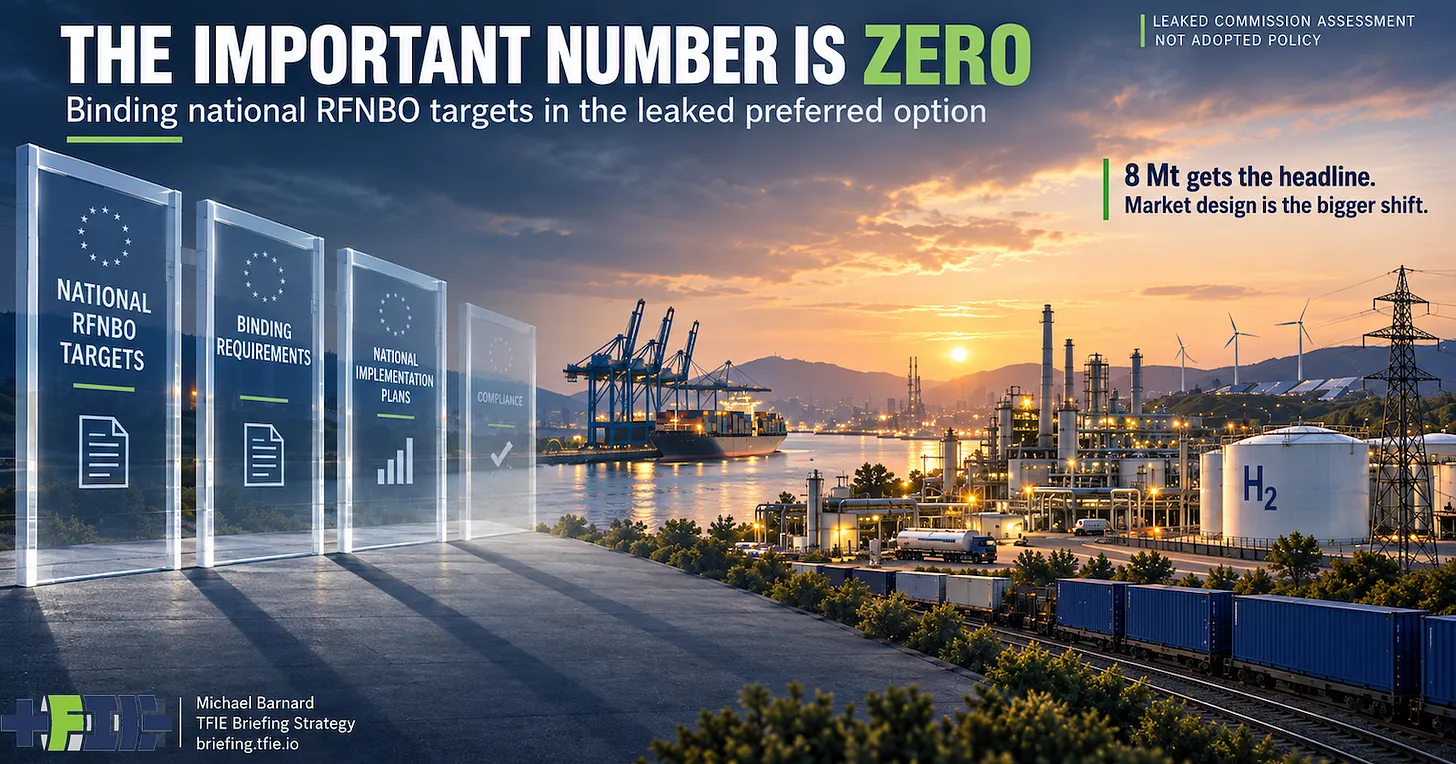
A leaked European Commission staff impact assessment points toward a different architecture after 2030. Under the L2 measure included in the draft preferred package, binding national RFNBO consumption targets would disappear. In their place would be an indicative EU-level renewable-hydrogen target, financing and enabling measures, and a credit mechanism intended to create demand without requiring every member state to reproduce the same hydrogen market.
This remains a draft rather than settled European policy. The document contains placeholders and unresolved methodological material, while the Commission is still preparing the post-2030 renewable-energy framework for a legislative proposal expected before the end of 2026. The useful question is therefore not what Europe has decided, but what the preferred option reveals about the direction Commission staff are examining.
The full TFIE Strategy Briefing analysis follows what changes when compliance support can move through credits rather than being tied to national hydrogen-consumption quotas. The deeper issue is whether Europe can keep creating demand for decarbonisation while allowing evidence to change which hydrogen applications, projects and locations receive that demand.
The leaked assessment also contains a substantial numerical reset. Its central scenario models 18 million tonnes of electrolytic hydrogen consumption in 2040, compared with eight million tonnes in the low-hydrogen case and 20 million tonnes in the high case.
Source link