This article has been reviewed according to Science X's editorial process and policies. Editors have highlighted the following attributes while ensuring the content's credibility:
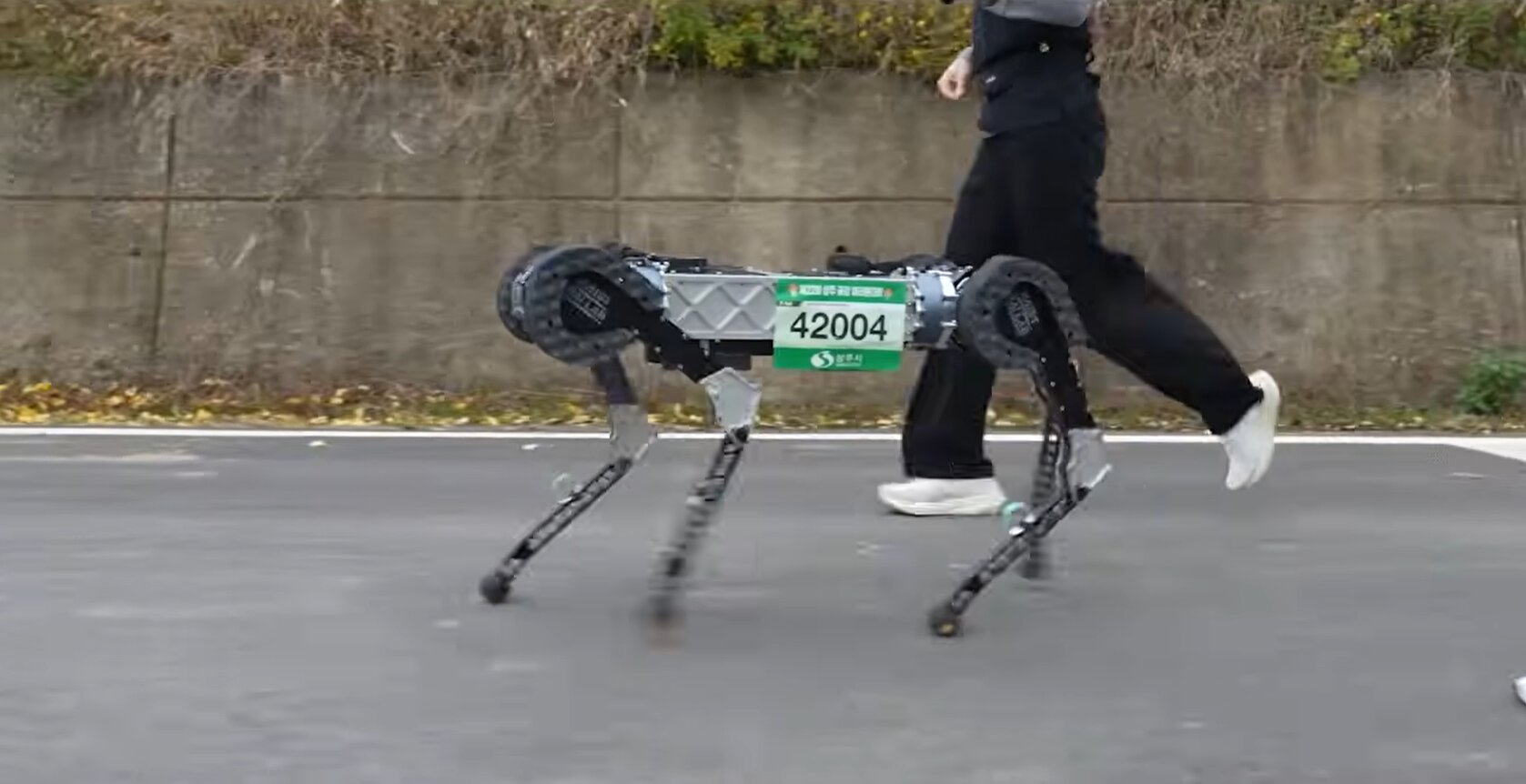
A four-legged robot that can complete a marathon on a single battery charge has been demonstrated by a team from KAIST. The robot, which completed the Sangju Marathon in South Korea in 4 hours and 19 minutes alongside human runners, traveled three times as far per charge than existing robots and could pave the way for improved battery life in legged robots.
Legged robots have the potential to assist in rescue operations in mountainous or disaster-stricken areas. However, recent advances in quadruped robots have been limited by their ability to operate beyond approximately 20 kilometers (12 miles) because of limited battery life. Unlike robots on wheels, legged robots must continuously expend energy to support their body weight and compensate for energy lost with each 'step,' reducing the distance they can travel between charges.
In their article published in Nature, Jemin Hwangbo and colleagues present RAIBO2, a four-legged robot designed to reduce energy loss through both software and hardware. Its features include lightweight legs, optimized motor-driving circuits and movement rules reinforced by machine learning.
9 miles per hour), navigating a notoriously difficult course with 286 meters (938 feet) of elevation change and slippery sections of terrain. 25 (a measure of the energy expended during motion, factoring in the weight of the robot).
Source link