

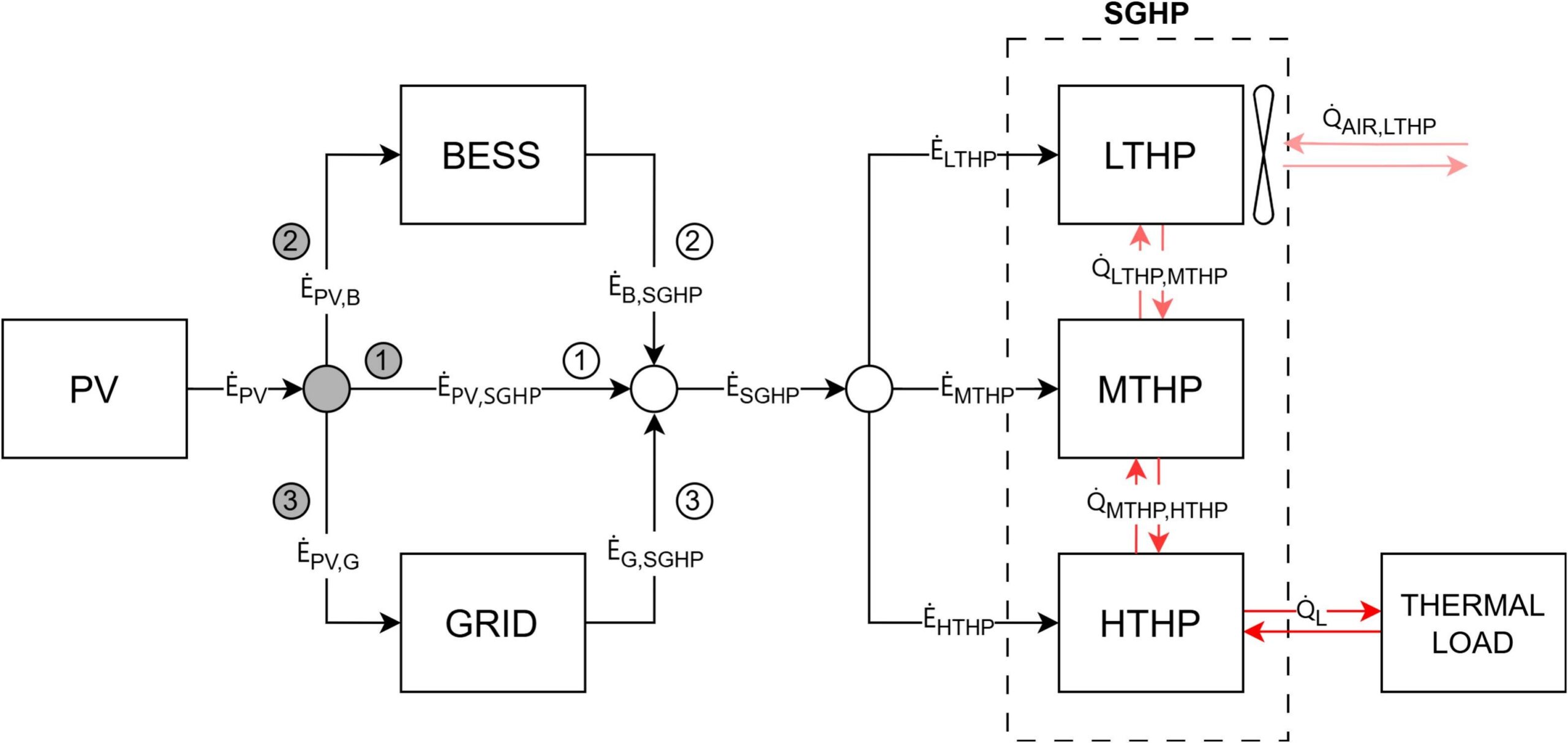
Researchers at the University of Cagliari in Italy have designed a hybrid energy system that combines a three-stage air-source heat pump for industrial steam generation with on-site PV, battery energy storage and the electricity grid.
Unlike conventional high-temperature heat pump systems that rely on industrial waste heat, the proposed system extracts heat directly from ambient air, allowing it to produce steam without an available waste-heat source. The researchers optimized the PV and battery capacities to minimize the levelized cost of heat (LCOH), with the grid providing additional electricity when required.
“The proposed system couples a three-stage steam-generating heat pump (SGHP) with on-site PV, battery storage, and the electricity grid, optimizing the PV and battery capacities to minimize the levelized cost of heat,” lead author Luca Migliari told pv magazine. “We found that the economic viability of steam-generating heat pumps depends not only on their efficiency, but also on how their electricity supply is designed.”
“Our results also showed how the cost-optimal configuration shifts from grid-dependent operation to PV-supported and higher-autonomy solutions as electricity prices increase,” he added. “They also highlight that solar availability has a much stronger influence on the economic benefits of PV and storage than ambient temperature.”
In the study “Techno-economic assessment of an air-source steam-generating heat pump with optimal PV–BESS integration,” published in Energy Conversion and Management, the research team explained that the economic viability of PV-BESS-integrated industrial heat pumps depends strongly on local solar resources and electricity prices.
The proposed system follows a fixed dispatch hierarchy that prioritizes locally generated solar power.
Source link





