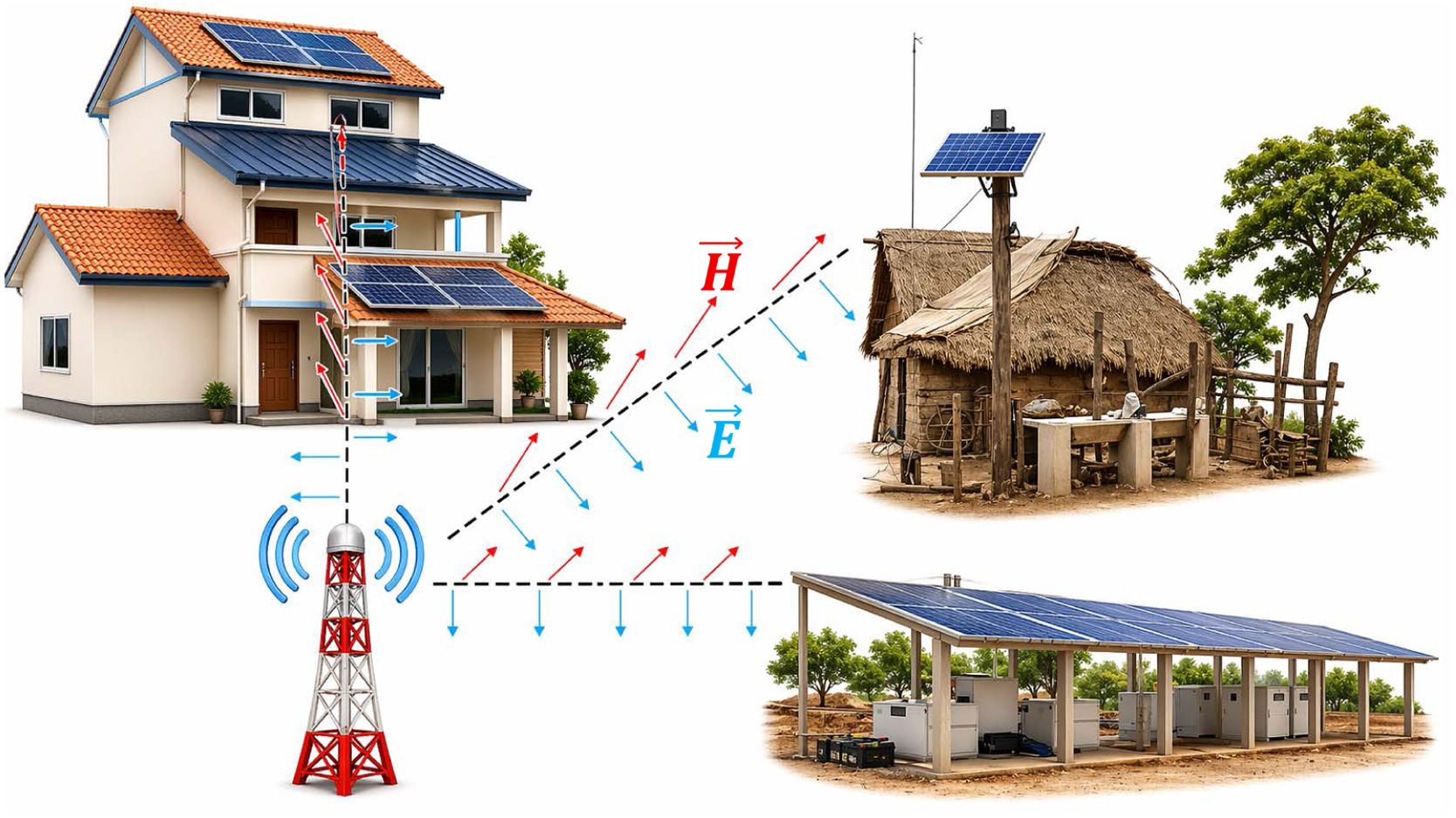
A research team in Burkina Faso has investigated how exposure to electromagnetic fields near a base transceiver station (BTS) affects the electrical behavior and power conversion efficiency of PV modules. A BTS connects mobile devices to cellular networks via radio signals.
“Particular attention is given to the evolution of the series resistance (Rs) and shunt resistance (Rsh), which are key parameters governing PV efficiency and carrier transport mechanisms,” the group explained. “An in-situ experimental campaign was conducted near a multi-technology BTS installation, and the measurement setup and extraction procedures are detailed.”
The researchers conducted an outdoor experiment at Joseph Ki-Zerbo University in Ouagadougou, Burkina Faso, using a 50 W monocrystalline silicon PV module. They tested the panel at five positions along a single direction from a BTS supporting multiple radio technologies, with horizontal distances ranging from approximately 7.9 m to 50.8 m.
The measurements were performed at around 12:55 p.m. on Nov. 18, 2025, under clear skies and at an ambient temperature of approximately 27.5 C. At each position, the scientists used a triaxial PCE-EM29 meter to characterize the radio-frequency electromagnetic field and recorded the module’s current-voltage (I-V) curve.
They used the voltage and current at the maximum power point (MPP) to determine the optimal load resistance and calculated the differential resistance based on voltage and current variations between consecutive points on each I-V curve.
The academics then estimated the series and shunt resistances by averaging five differential resistance values near open-circuit and short-circuit conditions, respectively.
Source link