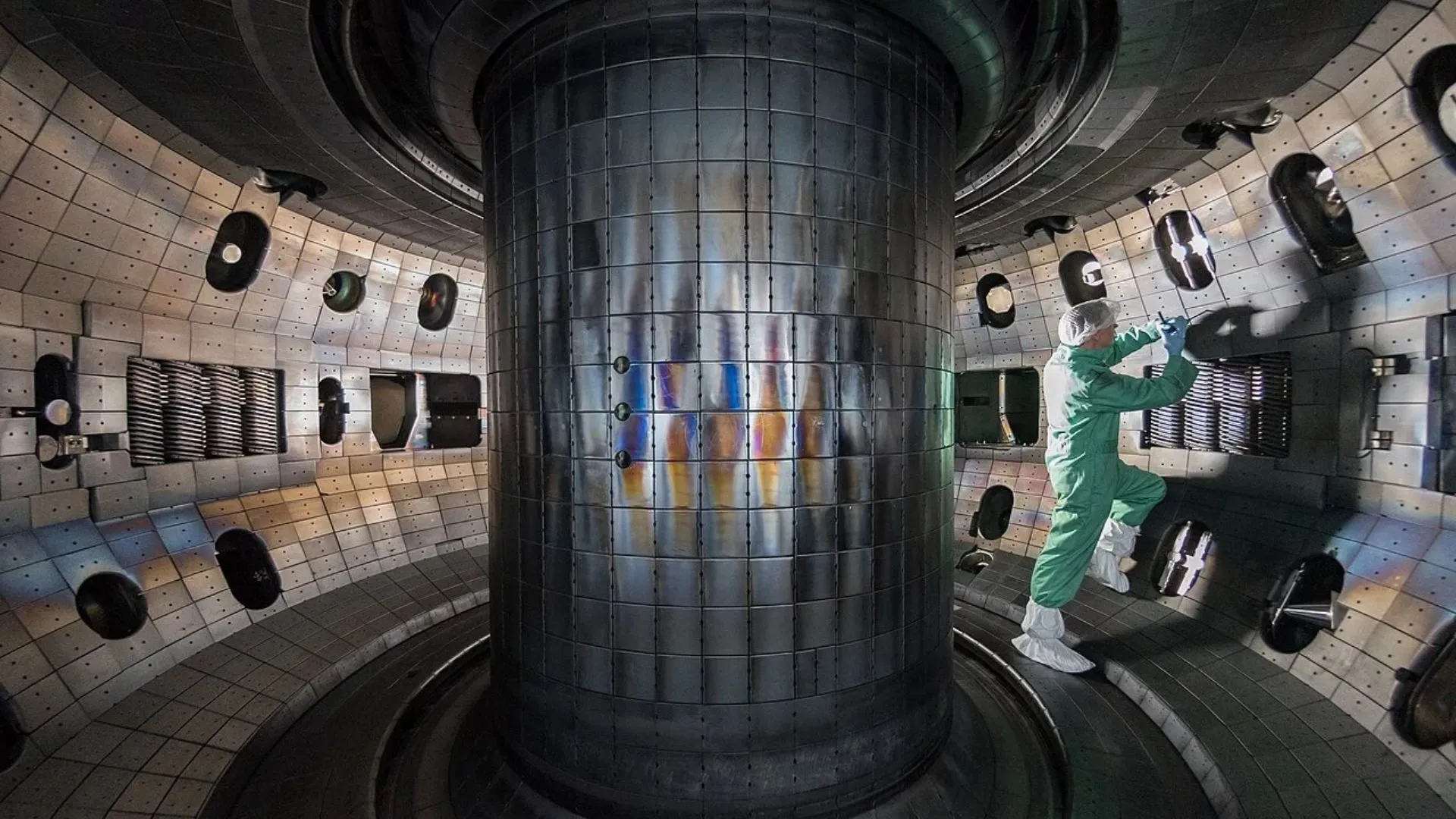
The Sun sustains nuclear fusion at a core temperature of about 15 million degrees Celsius (27 million °F). Yet scientists developing fusion reactors on Earth often aim for temperatures above 100 million degrees Celsius (180 million °F).
If the goal is to harness the process powering our nearest star, why does the fuel needs to become so much hotter?
The answer involves more than heat. The Sun’s gravity confines dense plasma, while terrestrial machines must create conditions for useful fusion within a much smaller space. Their fuel and confinement methods also differ.
Reaching the Sun’s core temperature alone would therefore fall short of what many reactor designs require.
Fusion occurs when light atomic nuclei combine, releasing energy. Bringing them together is difficult because nuclei carry positive electrical charges and repel each other. They must approach closely enough for the attractive nuclear force to bind them.
Inside the Sun, gravity compresses matter and confines the hot plasma. This provides a dense environment in which nuclei can interact. Magnetic confinement reactors operate with far thinner fuel, giving each nucleus fewer potential partners within a given volume.
Temperature describes the particles’ average kinetic energy. As the plasma gets hotter, its nuclei move faster, and a greater proportion of encounters occur at energies favorable for fusion.
Quantum tunneling also allows nuclei to penetrate the electrical barrier that would otherwise keep them apart. This process matters in both stars and laboratory fusion.
However, higher temperature cannot compensate indefinitely for inadequate density or rapid energy losses.
Source link