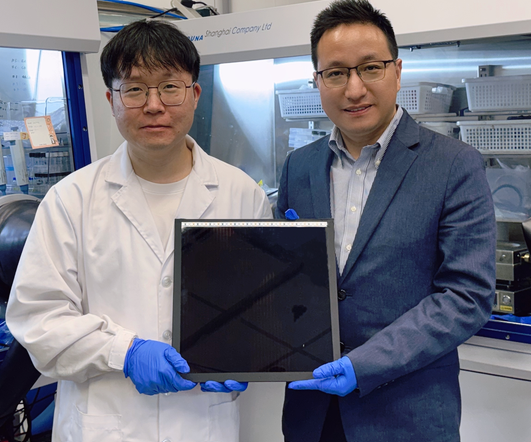
Scientists at the Hong Kong University of Science and Technology (HKUST) have developed a perovskite solar cell with a novel interface engineering technique aimed at simultaneously improving power conversion efficiency, operational stability and device-to-device reproducibility.
Dubbed trans-interface engineering (TIE), the proposed approach addresses mechanical failure at the interface between the perovskite absorber and the charge transport layer, which remains a major obstacle to the industrialization of perovskite PV technology.
Conventional interface engineering strategies rely on planar interlayers to passivate defects and improve mechanical interlocking between adjacent layers. These approaches, however, often involve a trade-off between efficient charge transport and interfacial stability.
To overcome this limitation, the researchers developed vertically aligned, mechanically robust nanolinks that penetrate both the perovskite absorber and the charge transport layer, rather than forming a discrete interlayer between them.
As a proof of concept, the research team incorporated trifunctional and monofunctional organic linkers into the perovskite and charge transport layers, respectively. It then used cyanoisopropyl radicals derived from azobisisobutyronitrile (AIBN) to initiate polymerization of the organic linkers within their respective layers.
This radical-mediated process also enables the linkers to form vertical bonds across the heterointerface, creating a covalently interconnected structure that reportedly facilitates charge transfer while improving resistance to mechanically induced degradation.
The resulting interface exhibited superior mechanical reliability compared with previously reported interface engineering approaches. The researchers attributed this improvement largely to the suppression of interfacial mechanical failure during device operation.
67%. The name of the certification body was not disclosed.
Source link