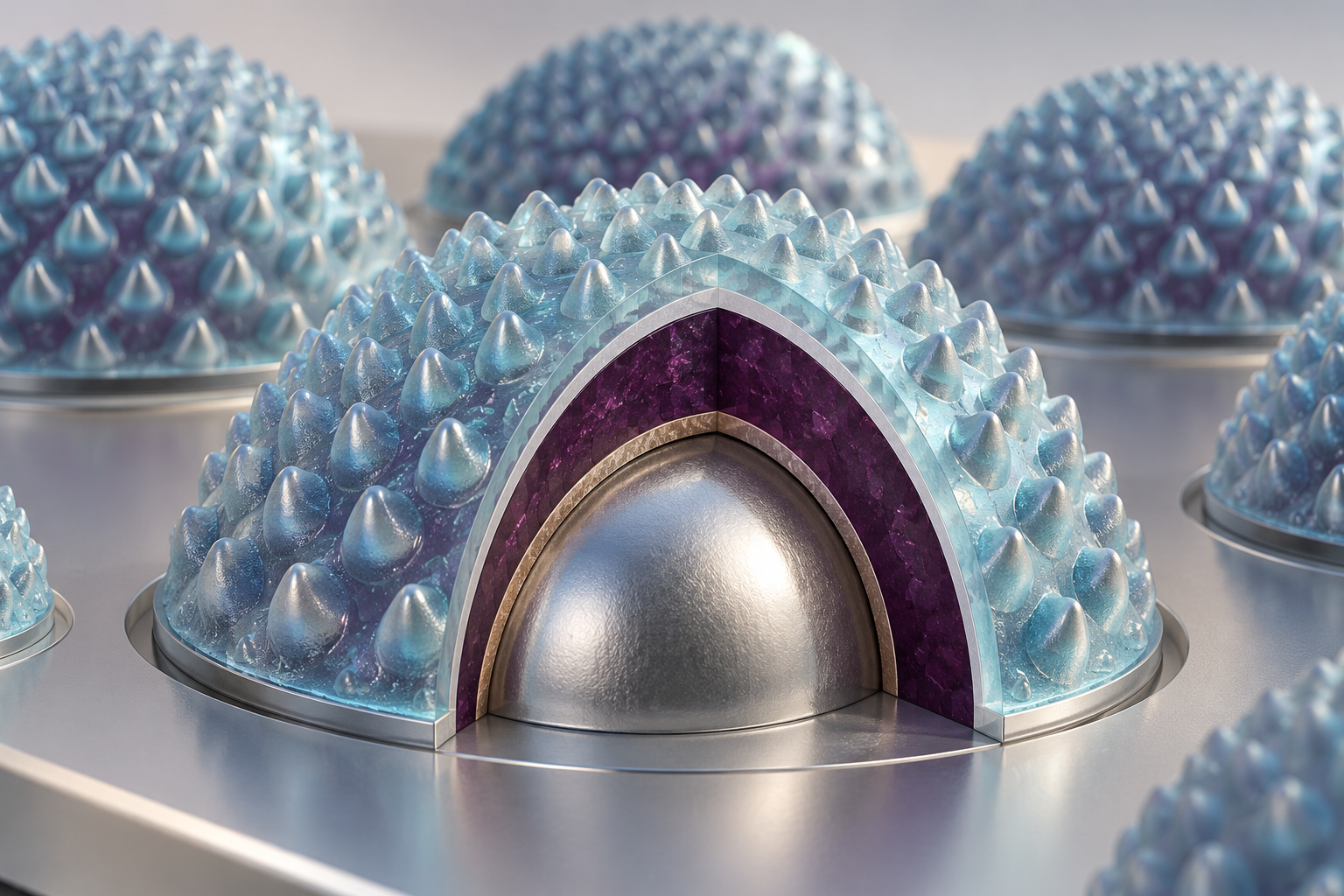
A research team in China has proposed a hemispherical perovskite solar cell with a textured surface designed to reduce sensitivity to the angle of incident sunlight. The hemispherical geometry is intended to enable radial charge collection, while the textured surface scatters incoming light in multiple directions to enhance absorption and promote more uniform charge generation.
“Perovskite solar cells have attracted intensive research interest as a promising candidate for next-generation photovoltaic technologies, offering high power conversion efficiency and low manufacturing cost,” the researchers said. “However, the practical energy yield of conventional planar perovskite cells is severely compromised by optical losses under varying solar incidence angles, leading to significant power fluctuations that undermine their viability for renewable energy generation.”
To evaluate the design, the researchers modeled five cell architectures: planar, nanowire, smooth hemispherical, and hemispherical structures with rounded-cone or textured rounded-cone front surfaces. Each device consisted of an indium tin oxide (ITO) electrode, a phenyl-C61-butyric acid methyl ester (PCBM) electron transport layer, a methylammonium lead iodide (CH₃NH₃PbI₃) perovskite absorber, a nickel oxide (NiO) hole transport layer, and a silver (Ag) rear electrode.
The researchers used Lumerical software to simulate the five architectures, analyzing light absorption, scattering, electromagnetic fields, and charge generation across wavelengths ranging from 300 nm to 800 nm and incidence angles from 0° to 50°. They then incorporated the resulting charge-generation profiles into electrical simulations that accounted for carrier transport and recombination. The simulations were used to calculate current-voltage characteristics, power conversion efficiency, and maximum power output under different illumination angles.
Source link