This article has been reviewed according to Science X's editorial process and policies. Editors have highlighted the following attributes while ensuring the content's credibility:
When trying to figure out a better design for a bacteria-powered biobattery, Binghamton University researchers found inspiration in nature—specifically, the insides of our small intestines.
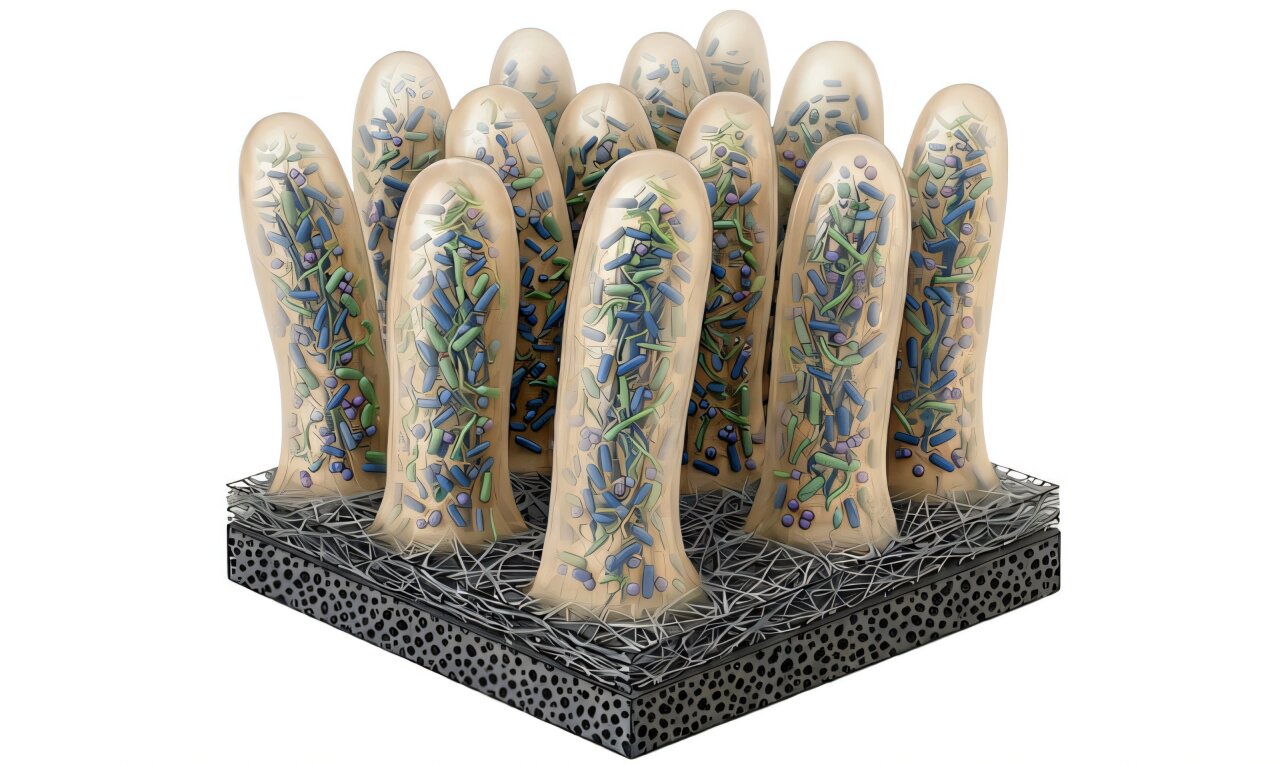
Fingerlike protuberances called villi line the digestive tract and are covered with microorganisms that help us to digest our food. Their shape and behavior also prove to be ideal for generating bioenergy using spore-forming bacteria.
Professor Seokheun "Sean" Choi and Ph.D. students Ruohan "Astrid" Zhang and Botian Wang from the Thomas J. Watson College of Engineering and Applied Science's Department of Electrical and Computer Engineering recently published their findings in the journal Small.
Choi's previous research has explored a variety of biobattery configurations with paper, fabric, metal and polymers, and he is trying to integrate them into 3D-printed circuits. He's even created an ingestible biobattery that remains inert until it activates in the small intestine.
As a pioneer of papertronics, Choi is most interested in using paper as the medium. One limitation he's discovered among nearly all the materials he's tried: two-dimensional configurations don't offer enough surface area for the spore-forming Bacillus subtilis bacteria to thrive. The porous nature of paper offers limited three-dimensional possibilities but can lead to performance issues.
"Porous structures can be easily clogged by biofilm formation, so we had a lot of problems with nutrient delivery, waste buildup or uneven biofilm growth," said Choi, who leads the Bioelectronics and Microsystems Lab.
Source link