
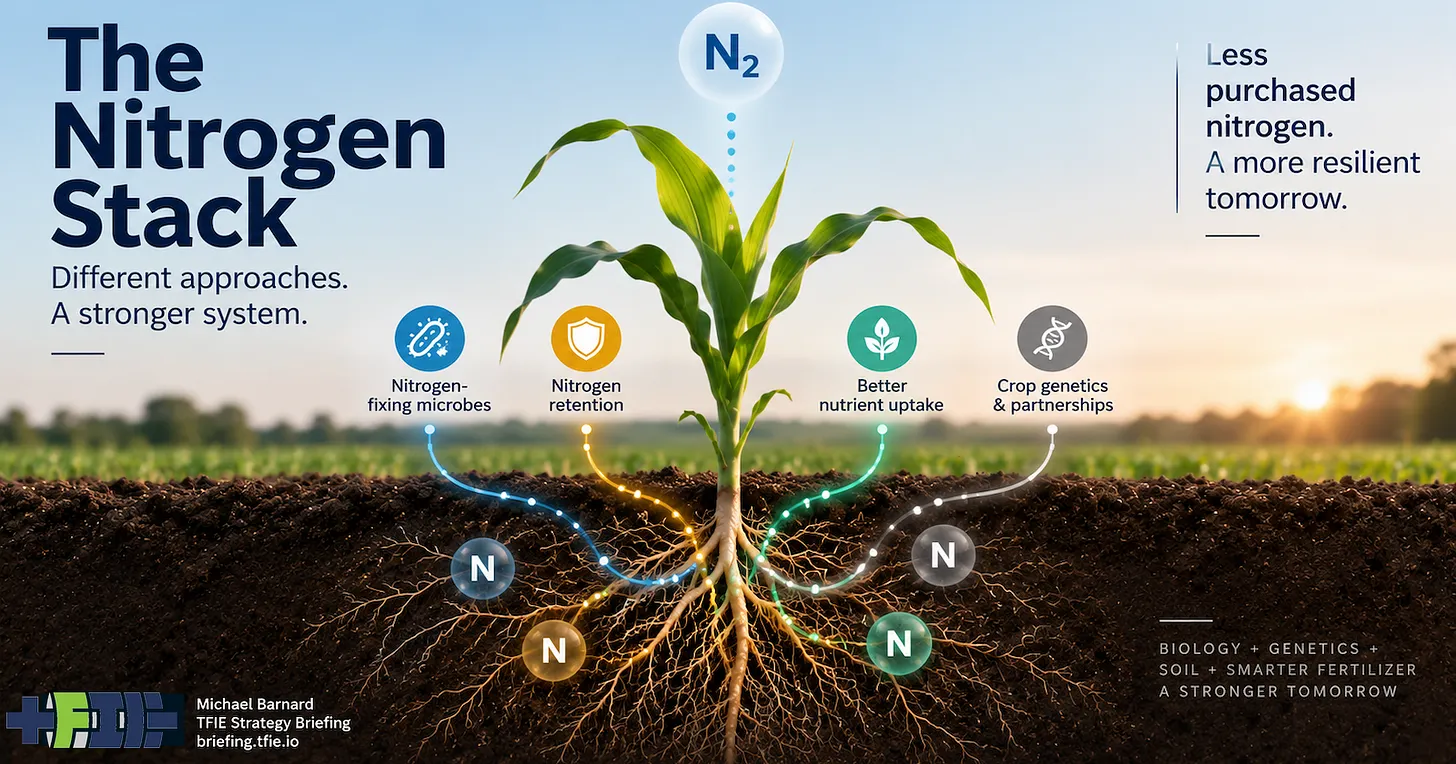
Modern farming depends heavily on nitrogen fertilizer because crops need nitrogen to build proteins, chlorophyll and ultimately yield, yet most major crops cannot directly use the nitrogen gas that makes up most of the atmosphere. Farmers have to buy nitrogen in forms plants can use, generally through ammonia, urea and nitrate fertilizers produced industrially at enormous scale. That system has underpinned modern agricultural productivity, but it also exposes food production to natural-gas prices, industrial energy costs and the environmental consequences of nitrogen that escapes into air and water.
Agricultural technology companies have spent years trying to reduce that dependence with biology. Some—including PivotBio, whose co-founder Karsten Temme I spoke with years ago—are developing microbes that can convert atmospheric nitrogen into forms plants can use, while others are trying to keep fertilizer in the root zone longer, stimulate roots so crops capture nutrients more effectively, or breed plants that interact more productively with microorganisms. Those products can all lead to marketing claims about reduced fertilizer use, but the biological processes behind the claims are substantially different and can interact once they are applied to the same crop.
The distinction is central to my TFIE Strategy Briefing analysis of farming’s emerging nitrogen technology stack , which looks at the technologies as parts of one crop system rather than as isolated product categories. The detailed Briefing is aimed at investors and corporate strategists, but the underlying farming issue is straightforward: several technologies may help reduce purchased fertilizer, and their benefits cannot be assumed to add together.
Source link