
In 2015, the world made six solar panels a second. In 2026, it’s on track to make ten times as many.
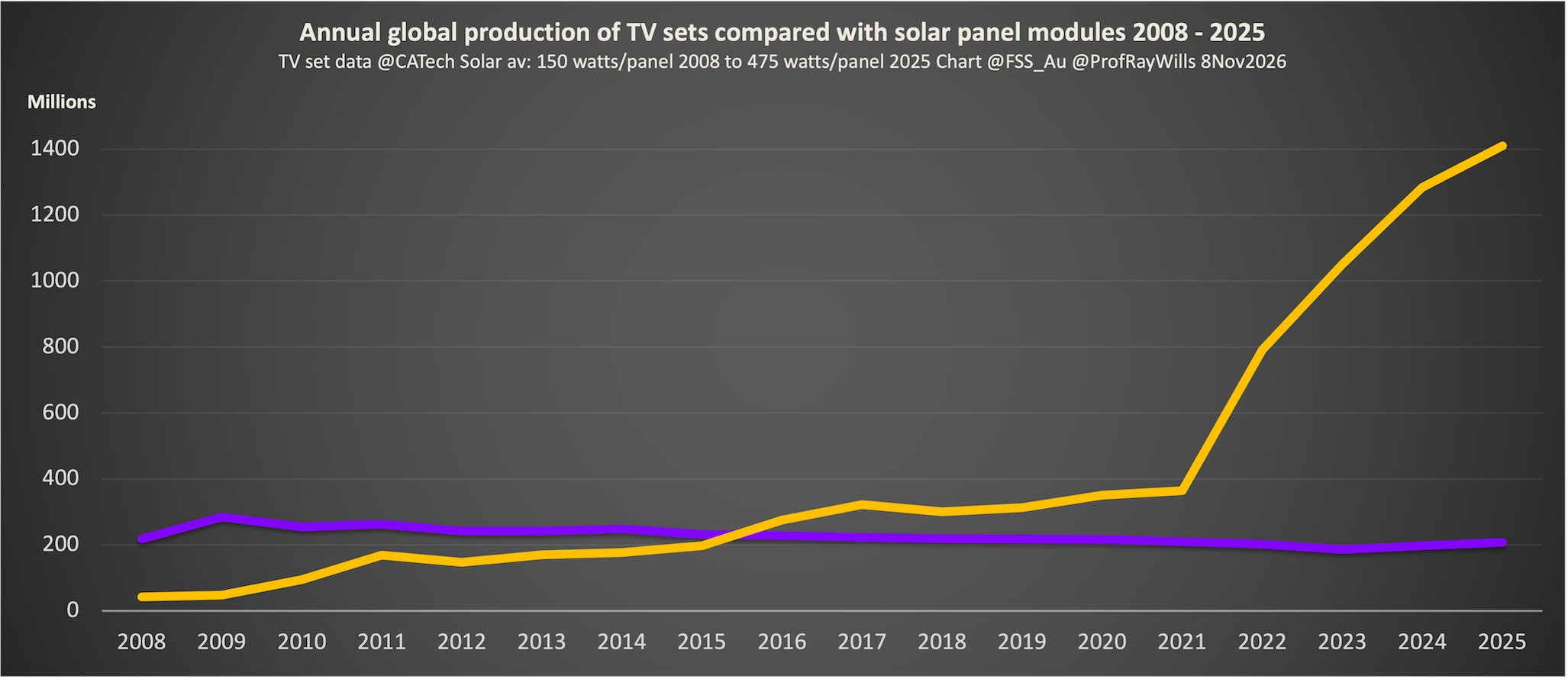
At an Australian clean-energy conference in 2015 hosted by Renew Economy Disruption and the Energy Industry conference, I posed a simple test for the solar boom. If the world was still making more panels that consumed electricity — TVs — than panels that generated it, I reckoned we hadn’t quite seen the real boom yet.
By May 2018, when I spoke at Power Philippines in Manila, the crossover had become a line in journalist Lala Rimando’s live coverage of my talk: more solar panels were now being made than TV sets.
We are now making more solar panels than TV sets. Check out this slide by @ProfRayWills .#powerph18#solarph18https://t.co/UGjfZke4IM pic.twitter.com/Kkf6R41RHx
Passing televisions was an important milestone, but it’s really the least interesting part of the story.
In 2021, the world made an estimated 360 million solar panels. A year later, it made about 790 million. By 2025, annual production had reached about 1.4 billion panels, against just over 200 million televisions. The gap opened not because the world stopped making TVs, but because it started making solar panels on a much bigger scale.
Put another way, the world went from making about six solar panels a second in 2015 to about 45 in 2025, averaged across every second of the year. My full-year estimate for 2026 puts the rate at about 62 panels a second — nearly two billion panels in a year (Figure 2).
Source link