Germany’s solar power generation has exceeded 100 TWh for the first time on an annual basis, according to data from the Fraunhofer Institute for Solar Energy Systems (Fraunhofer ISE).
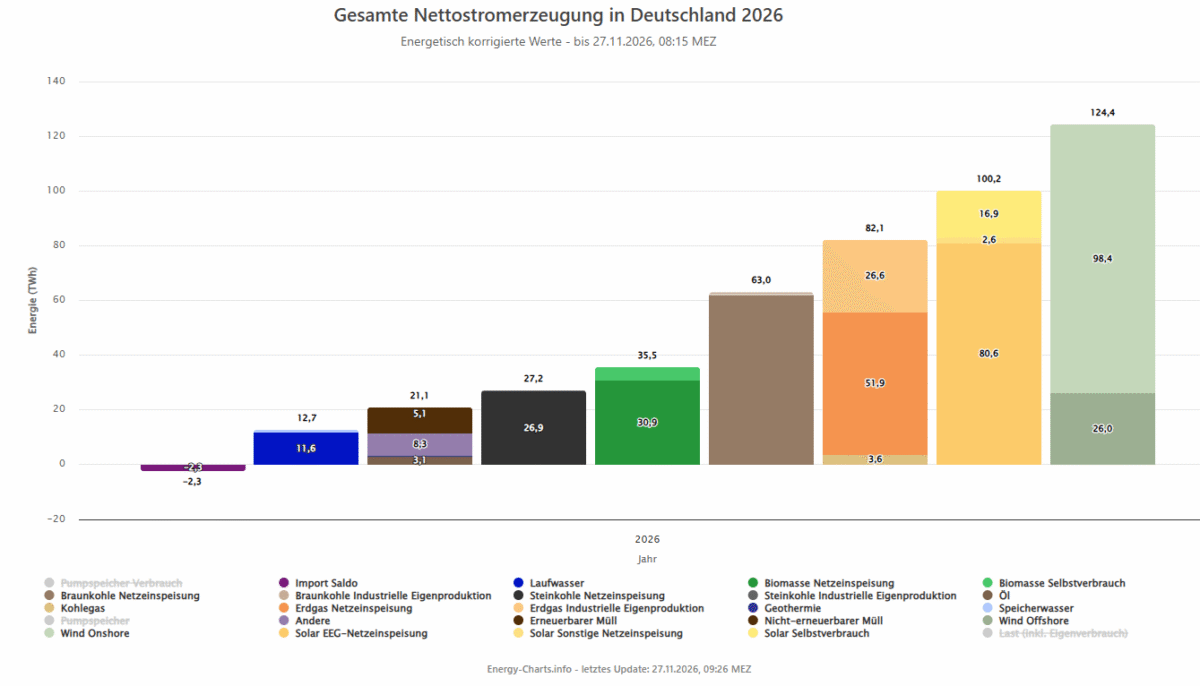
Bundesverband Solar- & Batteriewirtschaft (BSB), the German solar and battery trade group formerly known as Bundesverband Solarwirtschaft (BSW), said in mid-November that the country was approaching the milestone, citing figures from Fraunhofer ISE’s Energy-Charts platform. The institute’s data showed 100.2 TWh of solar generation by the morning of Nov. 27.
Of that total, 80.6 TWh came from grid feed-in by photovoltaic systems covered by Germany’s Renewable Energy Sources Act (EEG), while other PV systems supplied 2.6 TWh to the grid. Self-consumption accounted for a further 16.9 TWh.
Solar was Germany’s second-largest source of net electricity generation so far this year, behind wind power. Onshore and offshore wind farms generated 124.4 TWh. Gas-fired power plants produced 82.1 TWh, followed by lignite plants at 63 TWh and hard coal plants at 27.2 TWh. Combined, coal-fired generation remained below solar output.
Solar generation has increased by 10 TWh compared with 2025. Energy-Charts recorded 90 TWh of solar generation last year, comprising 67.9 TWh of feed-in from EEG-supported PV systems, 2.2 TWh from other systems and 19.8 TWh of self-consumption.
A decade ago, in 2016, solar generation totaled 36.8 TWh, almost one-third of this year’s output. Of that amount, 34.5 TWh was fed into the grid and 2.3 TWh was consumed directly.
The generation mix was also markedly different in 2016. 7 TWh. 7 TWh to the grid – also more than solar.
Source link