This article has been reviewed according to Science X's editorial process and policies. Editors have highlighted the following attributes while ensuring the content's credibility:
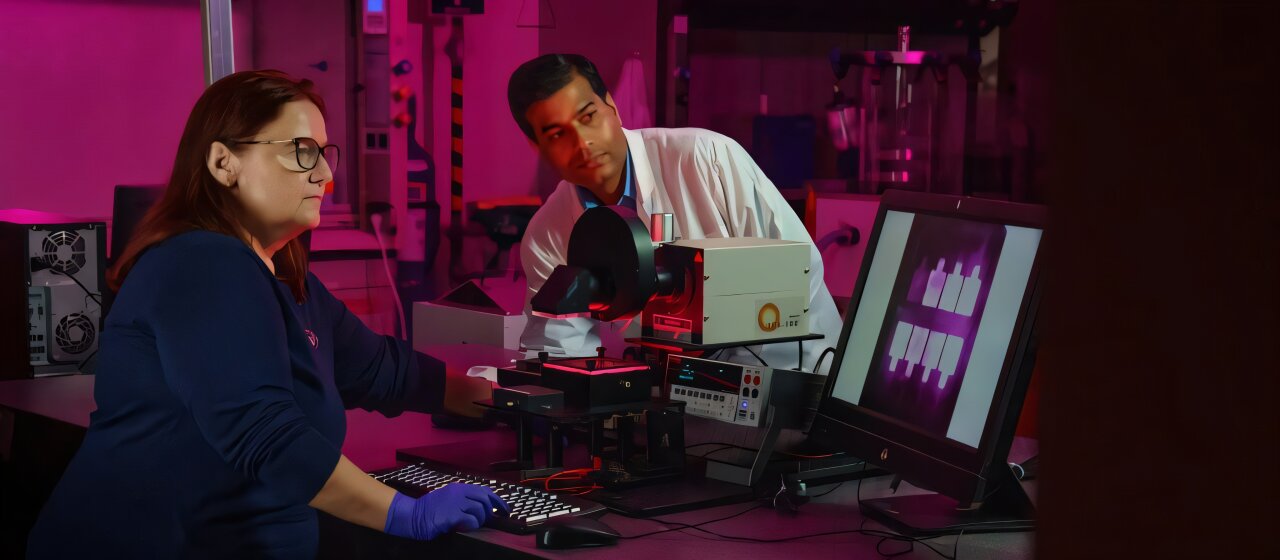
A U.S. soldier may carry up to 20 pounds (9 kilograms) of batteries to power communications equipment and other electronics on missions. New research from FIU could help lighten that load. A team of engineers has developed a dual-use, razor-thin solar device that can harvest sunlight to generate electricity and also produce light.
This innovation, which the researchers call "SOLED"—half solar panel, half light-emitting diode (LED)—is well suited for wearable power systems and could be stitched onto a soldier's uniform or gear, giving troops working in remote locations a stealthy way to generate power without the noise, heat or bulk of a generator. It could also enable new kinds of displays, sensors and other optoelectronic devices, giving warfighters greater flexibility in a contested logistics environment when supply routes are threatened.
"When you can turn sunlight into power and then use that same panel to produce light, you're potentially reducing a dependency on batteries, on generators and on resupply," said Daniela Radu, lead researcher and interim chair of mechanical and materials engineering at FIU's College of Engineering & Computing. "This is how we can increase energy resilience at the level of individual soldiers."
The device is built with a versatile semiconductor material called perovskite that converts sunlight to electricity at up to 22% efficiency, competitive with commercial solar technology. Run in reverse, it can emit light at nearly 11% efficiency, a significant jump over earlier versions of the technology, the research team says.
Source link