This article has been reviewed according to Science X's editorial process and policies. Editors have highlighted the following attributes while ensuring the content's credibility:
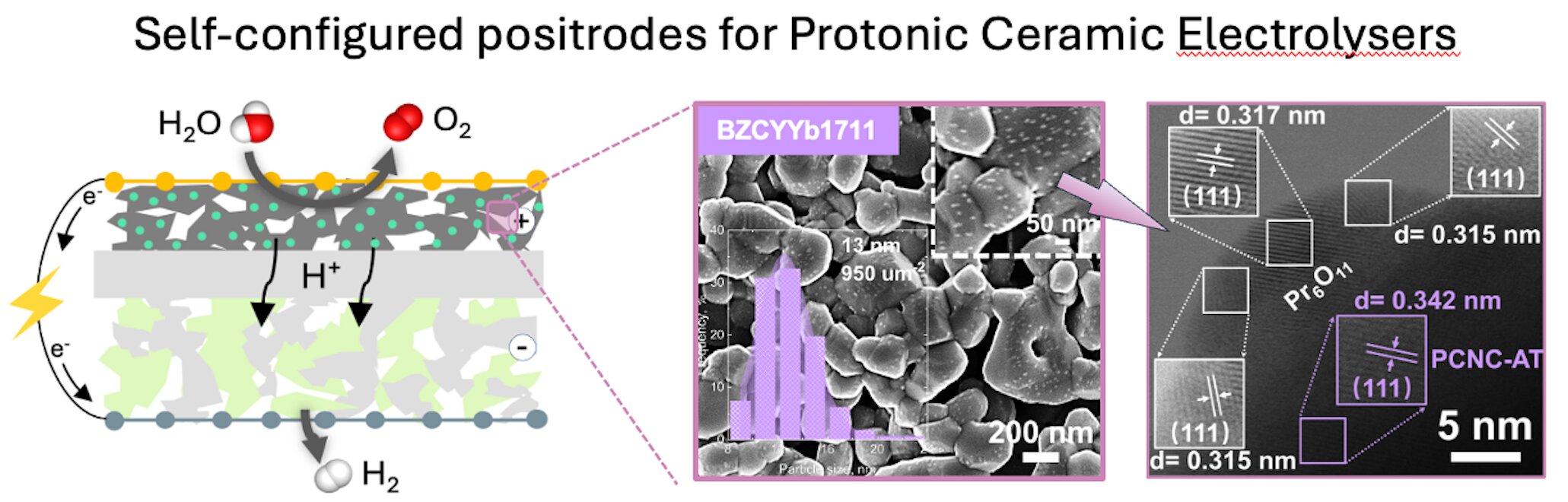
Many chemical processes require hydrogen, which is still being produced from fossil fuels. A protonic ceramic electrolyzer cell (PCEC) is a device that can produce hydrogen from water at temperatures that match key industrial processes. Researchers at the University of Groningen recently showed that careful coordination of materials in such a PCEC can double the production of hydrogen with the same electricity consumption. The results are published in Energy and Environmental Science on Oct. 14, 2026.
The process to produce hydrogen from water is not new, of course: Pass an electric current through a bowl of water, and the water (H₂O) is split into hydrogen (H₂) and oxygen (O₂). In a PCEC, this process is done with steam, which means the entire process (including the required heating) takes less energy.
The steam is split into oxygen (O₂) and hydrogen without an electron (H⁺). In the PCEC, there is a ceramic membrane, and only the hydrogen without an electron (H⁺) is small enough to pass through the pores of this membrane, attracted by a negative charge on the other side that allows it to form hydrogen (H₂) again. Because the other atoms do not fit through the membrane, the produced hydrogen is kept separate from the rest.
An important challenge for the development of such PCECs is splitting the steam with as little energy as possible, to allow hydrogen atoms to be recovered through the membrane.
Source link