This article has been reviewed according to Science X's editorial process and policies. Editors have highlighted the following attributes while ensuring the content's credibility:
The rare earth elements that help power electric vehicles, wind turbines, medical imaging machines and other advanced technologies may be hiding in an unlikely place: industrial wastewater.
Rice University researchers have developed an ultraporous material capable of pulling several valuable rare earth elements from complex waste streams, a potential step toward recovering critical minerals that might otherwise be discarded. The research was published in ACS Applied Materials & Interfaces.
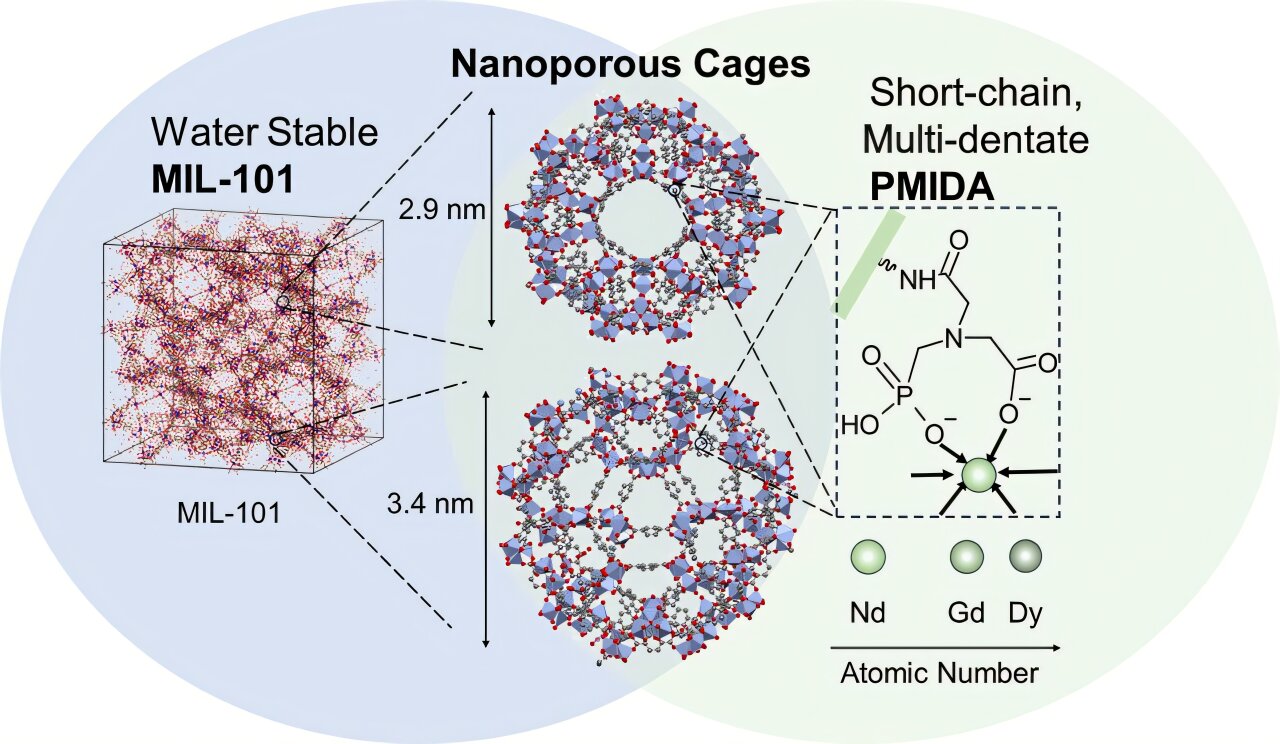
The approach uses metal-organic frameworks, or MOFs—Nobel Prize–winning materials built from metals and organic molecules into extraordinarily porous structures—and modifies their internal surfaces so they preferentially grab rare earth elements. The researchers tested the material on neodymium, gadolinium and dysprosium, three rare earth elements important to magnets and other technologies.
"Rare earth elements are essential to many of the technologies we rely on, but their supply chains remain geographically concentrated," said Qilin Li, the Karl F. Hasselmann professor of civil and environmental engineering at Rice and corresponding author of the study.
"Instead of viewing industrial wastewater only as something that needs to be treated, we can begin thinking of it as a resource containing valuable materials that may be worth recovering."
Rare earth elements possess unusual magnetic and electronic properties that make them difficult to replace in applications ranging from permanent magnets to aerospace and health care. Neodymium and dysprosium, for example, are used in powerful permanent magnets found in electric vehicles, wind turbines and drones, while gadolinium is used in MRIs.
Source link