
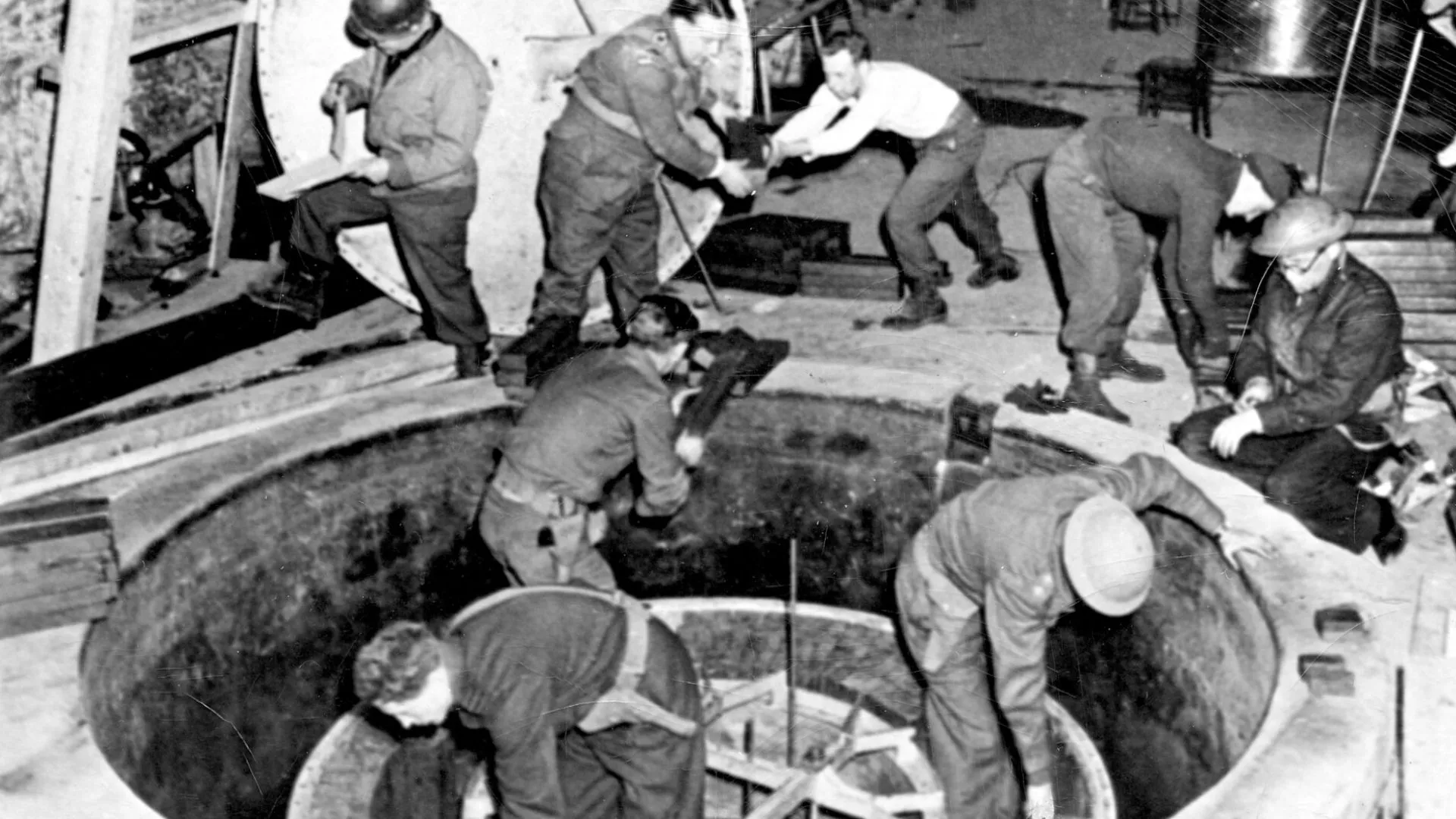
When the American forces in 1945 reached Nazi Germany’s final experimental nuclear reactor, the B8 pile, they found a machine that had never sustained a nuclear chain reaction.
They dismantled it, but a question lingered: how close had the Germans come to making it work?
Werner Heisenberg, the project’s scientific leader, later described the B8 pile as just short of success. Decades later, two surviving uranium cubes and a trail of wartime documents gave researchers a way to test that claim.
Timothy Koeth and his colleagues found a much larger obstacle than Heisenberg’s account suggested.
The reactor needed about twice the uranium it contained, and roughly twice the heavy water its Norwegian supplier produced during the entire war.
The B8 pile used natural uranium as fuel and heavy water as a neutron moderator. Both materials played distinct roles in the attempt to sustain nuclear fission.
When a uranium atom splits, it releases neutrons that can cause other uranium atoms to split. A reactor reaches criticality when enough of those neutrons trigger further fissions to maintain a chain reaction without it dying out.
However, neutrons released during fission move too quickly to efficiently sustain that process in the German design. The moderator slows them down, increasing their ability to cause additional fissions.
German scientists selected heavy water, which contains deuterium, a heavier isotope of hydrogen. Having uranium alone was therefore insufficient. The reactor also required enough moderator to support the chain reaction.
Koeth and his colleagues examined two natural uranium cubes from Germany’s wartime nuclear program alongside historical records, technical reports, correspondence, and other archival sources.
Source link





