A research team led by scientists at China’s Southeast University has developed a self-powered photovoltaic-thermoelectric generator (PV-TEG) system that integrates hotspot detection, local thermal management, and wireless monitoring into a TEG array.
Thermoelectric generators (TEGs) convert heat into electricity through the Seebeck effect, which occurs when a temperature difference between two dissimilar semiconductors generates a voltage. TEGs are commonly used in industrial applications to recover waste heat and convert it into electricity. However, their high costs and limited efficiency have so far restricted their wider adoption.
In PV-TEG systems, PV panels generate electricity during the day, while TEGs harness temperature differences to produce additional electricity.
“The key innovation of our research is that we go beyond the conventional role of TEGs as waste-heat harvesters,” corresponding author Jingming Cai told pv magazine. “We demonstrate that the electrical signals generated by these devices can also reveal where thermal anomalies occur within a PV module.”
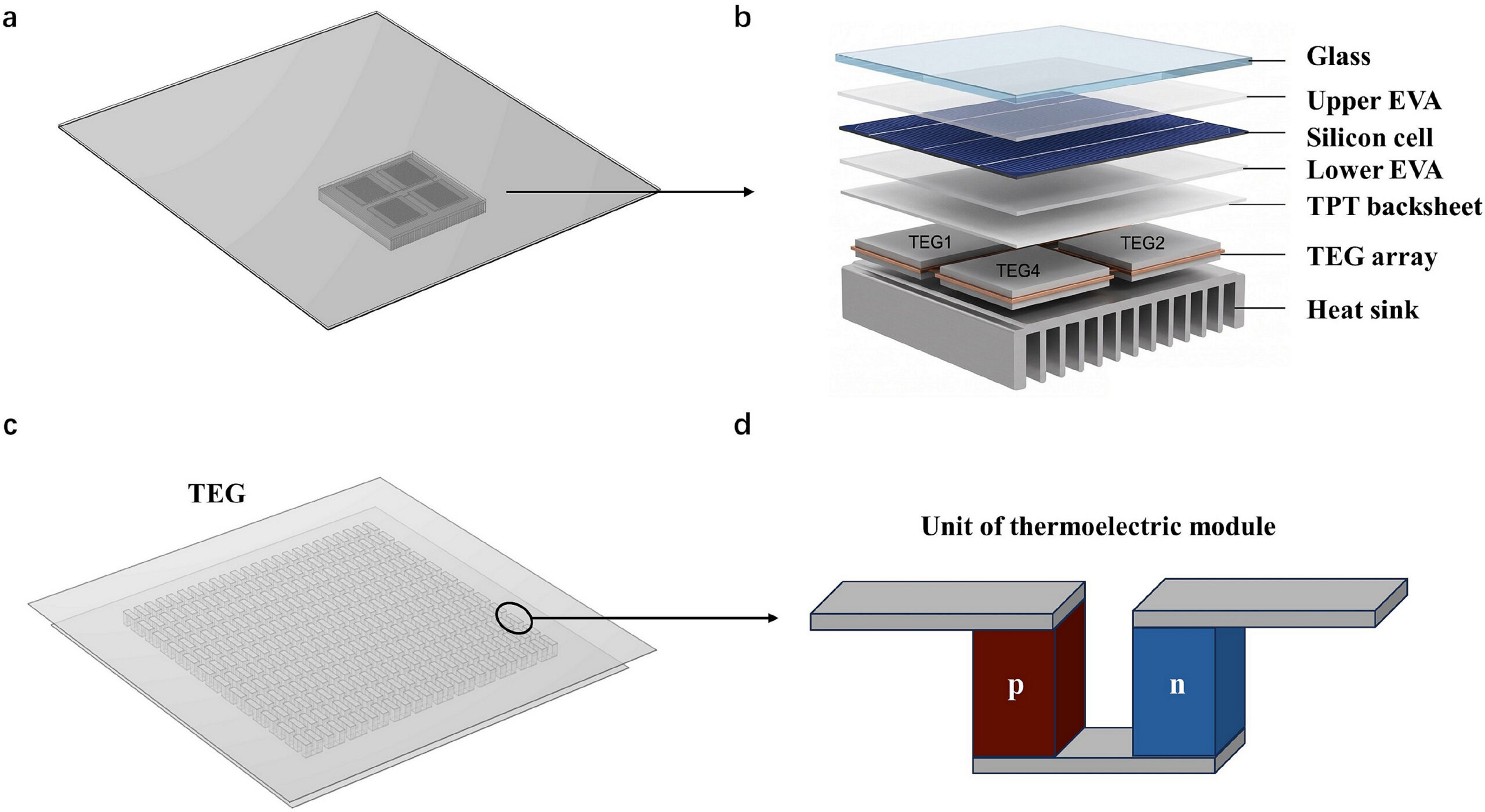
Cai said that by integrating four TEGs into a compact array, the researchers developed a system that combines hotspot localization, passive thermal management, energy harvesting, and wireless monitoring. “Essentially, we are turning the waste heat of solar panels into a source of both energy and diagnostic information,” he said.
The researchers first developed a three-dimensional multiphysics model of a 500 mm × 500 mm PV region equipped with four rear-mounted TEGs and an aluminum heat sink. The model coupled heat transfer and thermoelectric conversion under baseline conditions of 1,000 W/m2 irradiance and an ambient temperature of 25 C.
Source link