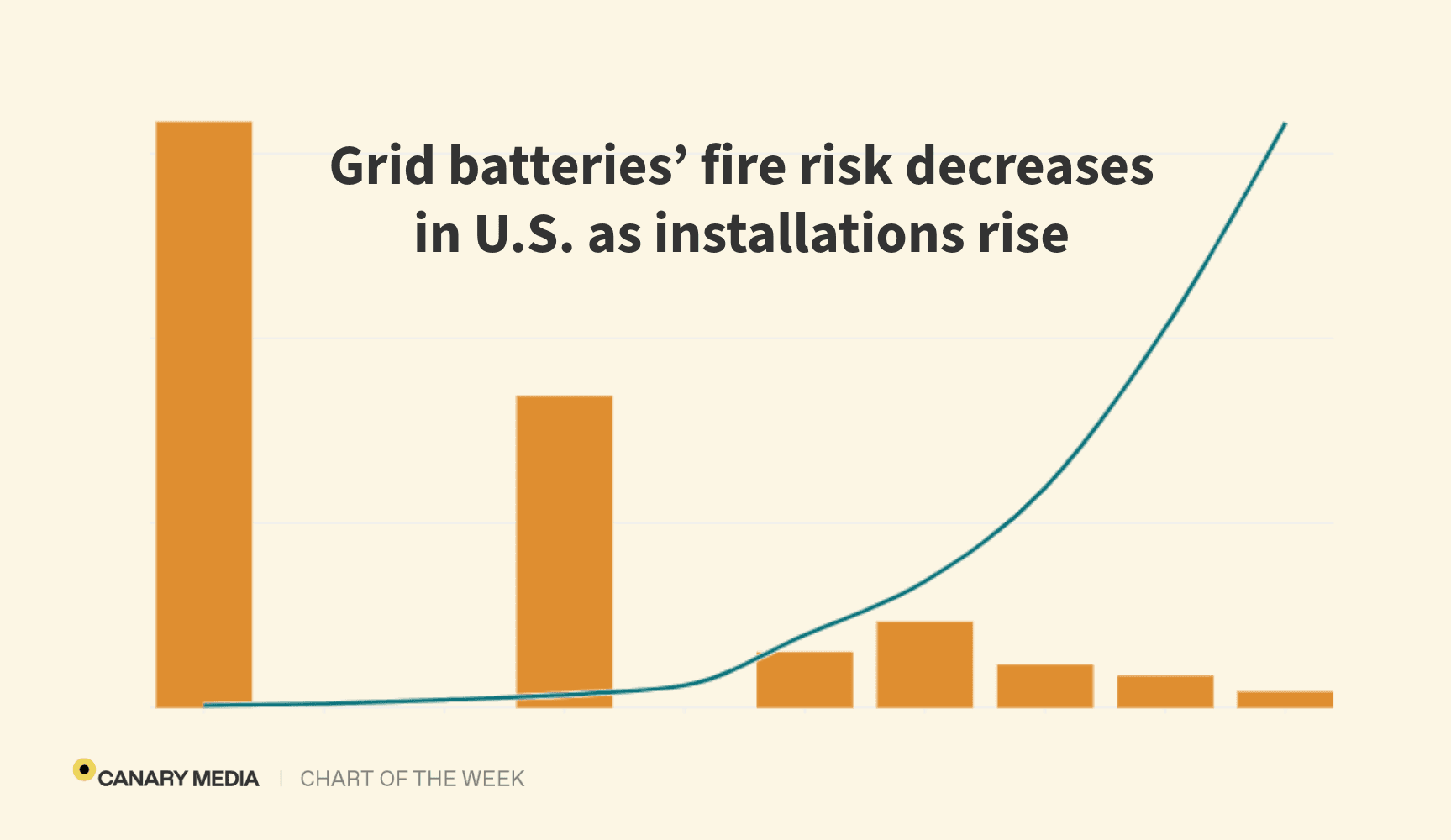
Concerns about fires loom large in communities, but data shows the tech is no more at risk of failure than boring legacy infrastructure like substation transformers.
See more from Canary Media’s “Chart of the Week” column.
Battery fires are like shark attacks: frightening events that loom cinematically large in the American psyche and almost never actually happen.
As batteries have become America’s top choice for new on-demand grid power, community concern about their fire risk has emerged as a limiting factor on the technology’s growth. There’s no disputing that battery fires have happened, and have been nigh impossible to put out by conventional means. But a dataset compiled by the nonprofit Electric Power Research Institute shows that these fires strike in the U.S. even less frequently than sharks.
A recent EPRI report plots global failures of commercial and grid-scale batteries — including arc flash, fire, and explosion events — and shows that the annual rate of failure has fallen precipitously as installations have grown exponentially. New safety standards have taken effect since the first big batteries were installed, and the batteries themselves, as well as project layouts, have grown more sophisticated and safe over the years.
That’s a great sign for an emerging technology: Even as a lot more of it enters the world, far fewer fiery failures are happening. But there’s a lot of variance from country to country in terms of rules around energy development and safety standards. S. in particular, we plotted EPRI ’s failure data alongside a tally of commercial- and utility-scale battery installations from the Solar Energy Industries Association in partnership with Benchmark Mineral Intelligence.
Source link