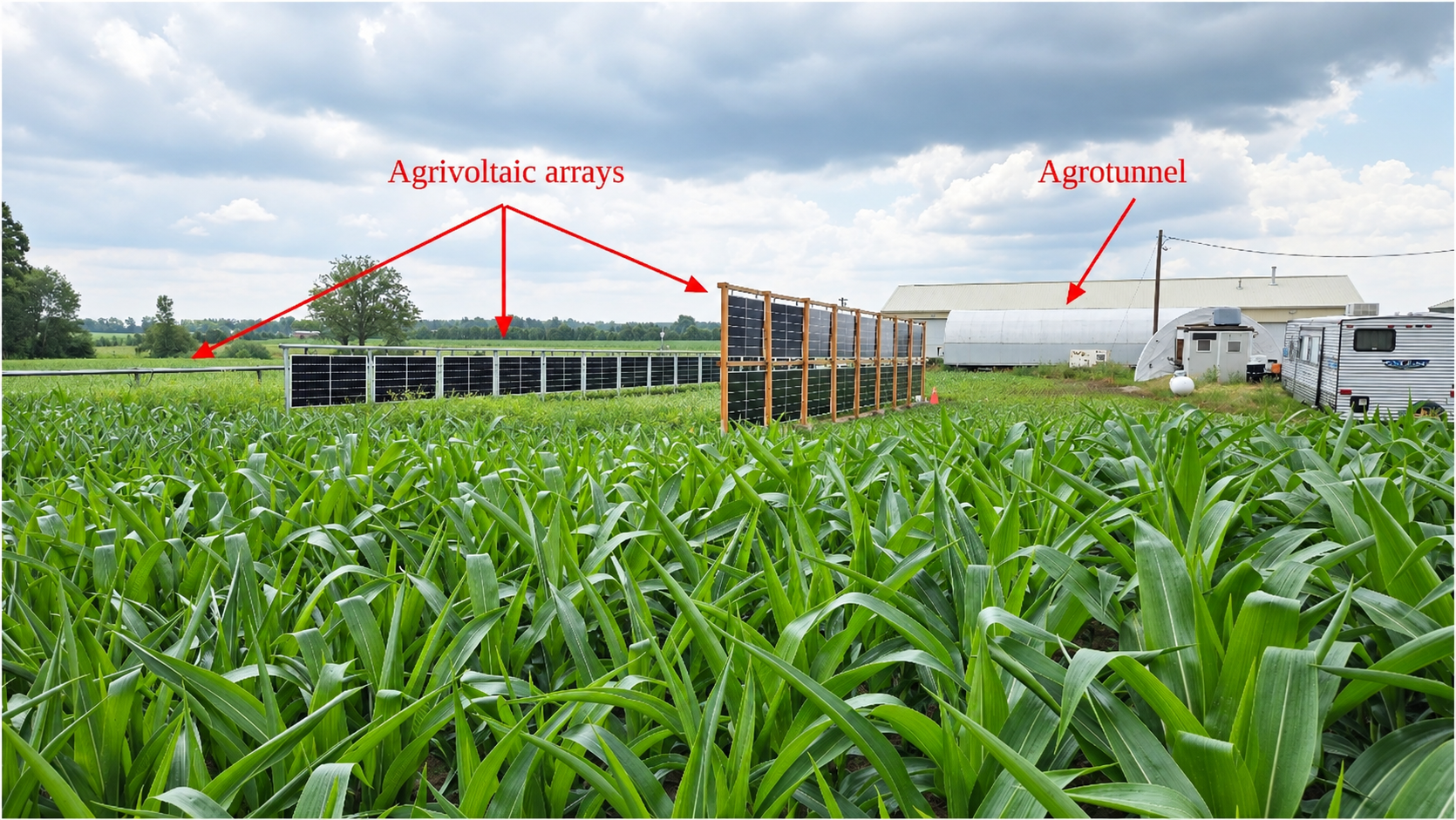
Researchers at Canada’s Western University have demonstrated that agrivoltaic installations can improve the profitability of indoor farming (IF) agrotunnels by reducing electricity costs.
These facilities are enclosed, tunnel-shaped structures that combine conventional agricultural polytunnels with indoor farming technologies. They provide controlled or semi-controlled growing environments, protecting crops from adverse weather, pests and diseases while potentially improving yields.
“We have known for a long time that there are a lot of environmental benefits of indoor farming. Sadly, many indoor farms go bankrupt because of high energy costs,” corresponding author Joshua Pearce told pv magazine. “This is where solar comes in, as it can provide known low-cost power that makes the economics of indoor farming much more attractive.”
The researchers conducted experiments in Ilderton, Ontario, focusing on Genovese basil grown at different planting densities and under different lighting conditions. They subsequently scaled the experimental findings to a commercial agrotunnel featuring 12,816 growing ports integrated into vertical cultivation walls. Their energy analysis accounted for electricity consumption by LED lighting, heat pumps, ventilation fans, dehumidifiers and irrigation pumps.
The team optimized a grid-connected, battery-free PV system to minimize electricity costs. It also assessed different lighting schedules and PV configurations using computational optimization techniques to identify the most cost-effective operating strategies.
The researchers developed a comprehensive economic model covering capital investment, operating and maintenance expenses, electricity costs and crop revenues. They evaluated the system across six North American locations – London, Montreal and Edmonton in Canada, and Boston, Santa Fe and San Francisco in the United States – to account for differences in solar resources, climate and operating costs.
Source link