There is much disagreement on the timing of the transition from copper interconnects to optical interconnects, but almost everyone agrees we are moving to all-optical interconnects over the next five years.
Optical interconnects already dominate scale-out. Optical interconnects will next move into scale-up by connecting racks in very large pods of hundreds to thousands of XPUs (AI compute units), then optical scale-up will replace copper within the rack.
Today, optical is dominated by pluggable transceivers mostly using single wavelengths (DR) with 2 or 4 fibers. Increasing performance using pluggables would require power-hungry higher-speed PHYs (physical layer interfaces) and/or more fibers, which will drive up costs because connectors cost more than fibers.
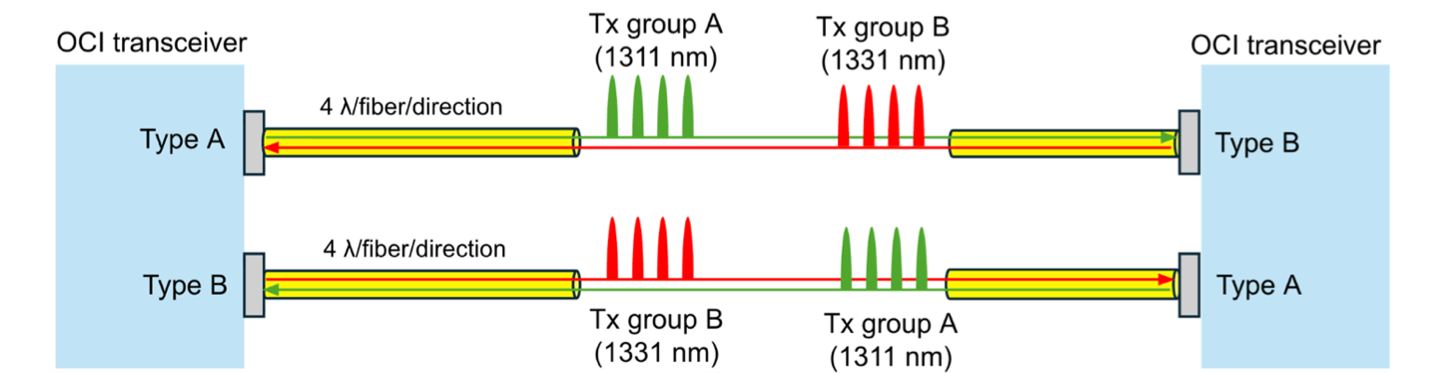
To reduce power and cost while increasing bandwidth, the industry consensus is shifting toward multi-wavelengths per fiber with bidirectionality, using NPO (near-packaged optics) then CPO (co-packaged optics). Alternatives may develop, but the emerging consensus for the future of optical interconnect appears to be OCI-MSA.
OCI-MSA (Optical Compute Interconnect Multi-Source Agreement) is an industry consortium recently formed for an open, interoperable optical interconnect spec for AI scale-up. Founding members include AMD, Broadcom, Meta, Microsoft, Nvidia, and OpenAI. In that mix are both GPU giants, the largest maker of custom AI compute, two of the hyperscalers, and one of the two Frontier Model companies. This is a big bandwagon. Of these, AMD, Broadcom, Meta, and Microsoft have made presentations on their plans for OCI-MSA at recent industry conferences.
Drew Alduino (Meta’s director of optical infrastructure), Near Margalit (VP & GM of Broadcom’s Optical Systems Division) & Matthew Streshinsky (AMD senior director for photonics) were on a panel in September at the AI Infra Summit.
Source link