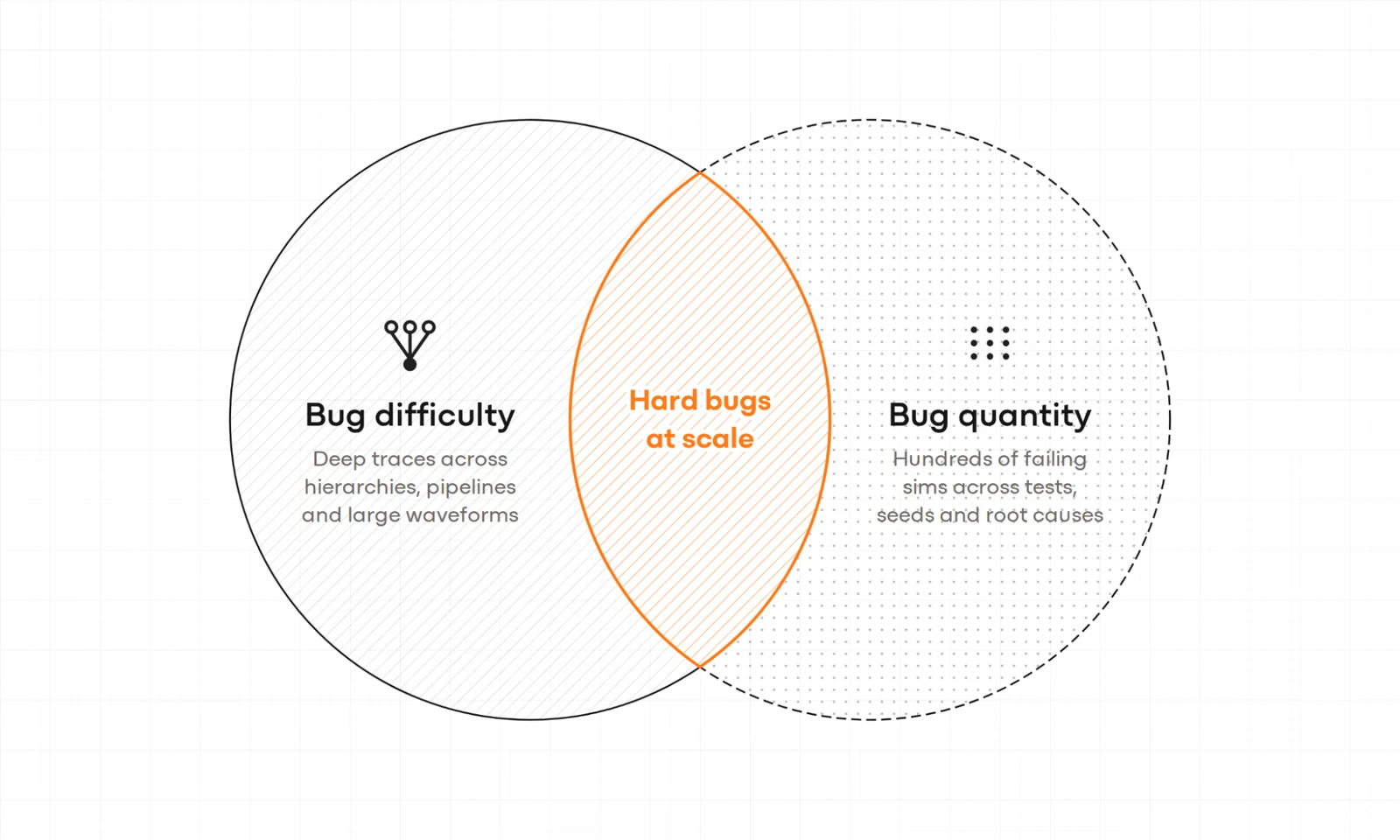
As semiconductor designs grow larger and more complex, debugging is becoming increasingly difficult to scale.
At DVCon earlier this year, Nvidia’s Stuart Oberman described first-silicon success as approaching a “statistical impossibility.” Semiconductor Engineering cites that debugging accounts for 44% of verification effort; a number reported in 2018, before the scale and complexity of today’s designs.
As designs get larger and design spaces are expanding, engineers are working across systems containing millions of gates. If design complexity continues to scale, debugging needs a fundamentally different approach. In this article, we will explain an AI-native approach to root cause analysis (RCA) and regression triage.
Some bugs require deep tracing across design hierarchies, long pipelines, large waveforms, and multiple interacting components before the actual root cause becomes clear.
ChipAgents RCA was designed specifically for this axis. Rather than treating debugging as a simple question-answering problem, the system approaches RCA as a search problem. It explores high-probability traces, executes across different hypotheses, ranks the resulting explanations, and provides confidence scores to the engineer.
The design contained a bidirectional serialization interface between a manager and subordinate. During a transaction, a reset was triggered by the subordinate while the manager continued transmitting a frame beyond the reset grace period.
Part of the transmitted data happened to contain the same value used to represent the protocol’s start code. The subordinate interpreted that payload as the beginning of a new frame, eventually causing a downstream failure.
Several conditions had to coincide: a reset needed to occur during the transaction, the data needed to resemble the start code, and the transmission needed to outlive the reset grace period.
Source link