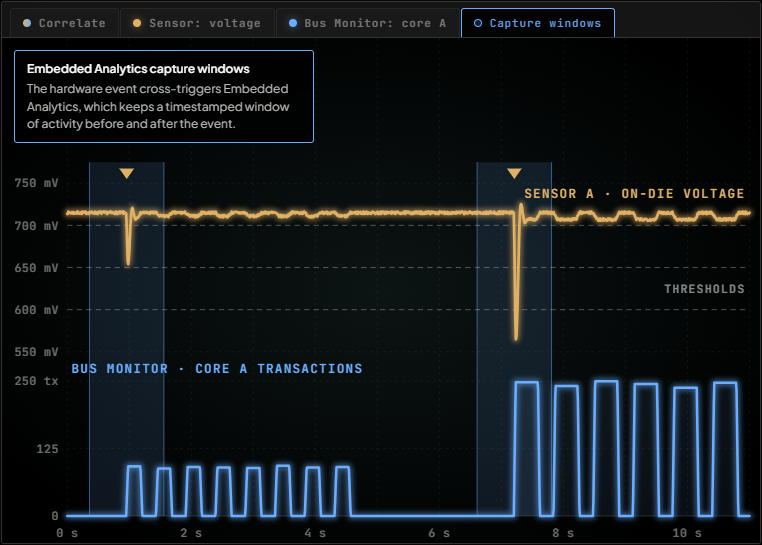
In a previous blog, we highlighted the importance of combining physical and functional sensors to plan for new workloads. This use case remains relevant for high-performance AI and HPC systems because ‘spiky’ workloads induce severe droops that dominate power budgets.
Your $1 billion ASIC just had a scan failure during an In-System Test. How can you tell whether the failure is an actual structural failure, or one caused by physical phenomena like voltage droop? Scan patterns can often generate intense switching activity when long or multiple chains are toggled, which may induce a voltage droop. If the failure is due to a voltage droop, you have a few options: slow the shift clock, raise the voltage, or repartition your scan patterns. Without physical sensors that report conditions during the test, teams can’t tell the two cases apart and might throw away good parts on false failures.
Co-mingling physical and functional sensors is necessary across the system lifecycle because functional and physical failures are connected. Let’s move further down the system lifecycle into silicon deployment for another example.
The previous demo combined the Movellus Aeonic Insight Droop Detector with Siemens Tessent Embedded Analytics to correlate voltage events with processor and interconnect activity. Today, we are proud to announce an extension of physical and functional monitoring for system lifecycle management: adding Tessent In-System Test (IST) to the demo. Running structural test on deployed systems means the false-failure question follows the part off the tester and into the field, where a wrong call can get a healthy node pulled from service.
Source link