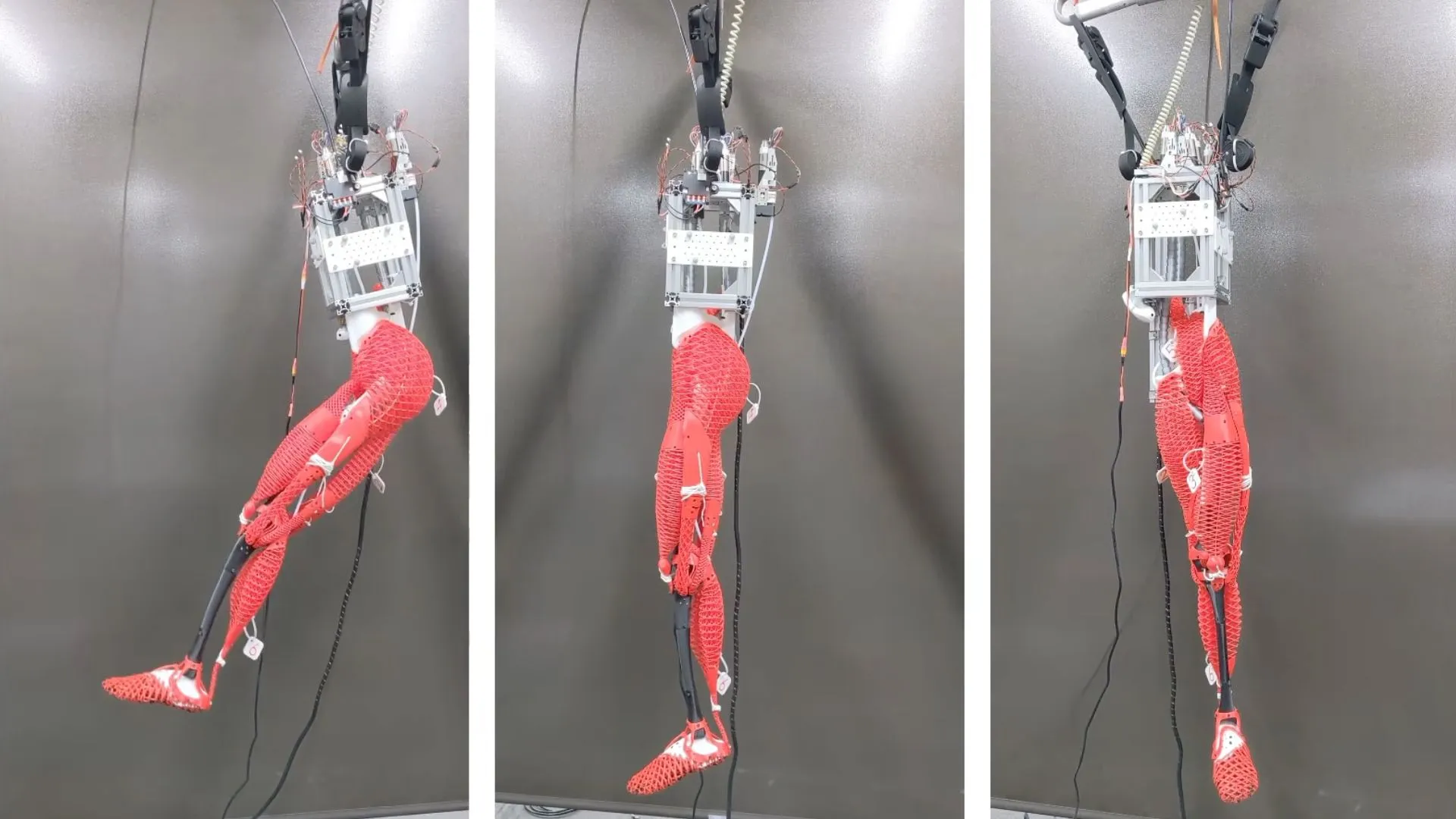
University of Tokyo researchers have developed a life-size robotic leg system featuring 3D-printed structures inspired by human muscles, tendons, and ligaments.
The design uses a single flexible plastic material, with different printed geometries giving each component distinct mechanical properties.
These structures provide muscle-like elasticity, tendon stiffness, ligament support, and cushioning in the feet, while electric motors and wires power the leg movements.
Although the prototype can demonstrate stepping with external support, achieving independent walking remains a challenge for future development.
The life-size robotic leg system uses 3D-printed flexible structures to replicate some of the mechanical properties of human muscles, tendons, and ligaments. The system uses a single thermoplastic polyurethane (TPU) material, with variations in printed geometry giving different structures distinct levels of flexibility, stiffness, and mechanical support.
Rather than manufacturing each component from a different material, the researchers use adjustable printing patterns to create muscle-like elastic structures, stiffer tendons, joint-constraining ligaments, and cushioned foot soles. The approach could simplify the design and fabrication of musculoskeletal robots by integrating different mechanical properties into a single material system.
According to the team, the project explored how the mechanical behavior of robotic body components can be controlled through their geometry. The researchers vary parameters such as lattice density and strut thickness to control how individual TPU structures respond to mechanical forces. These adjustments allow the same material to produce components with different mechanical characteristics. Softer printed regions behave like elastic muscles, while denser or thicker structures provide the greater stiffness associated with tendons.
Source link