This article has been reviewed according to Science X's editorial process and policies. Editors have highlighted the following attributes while ensuring the content's credibility:
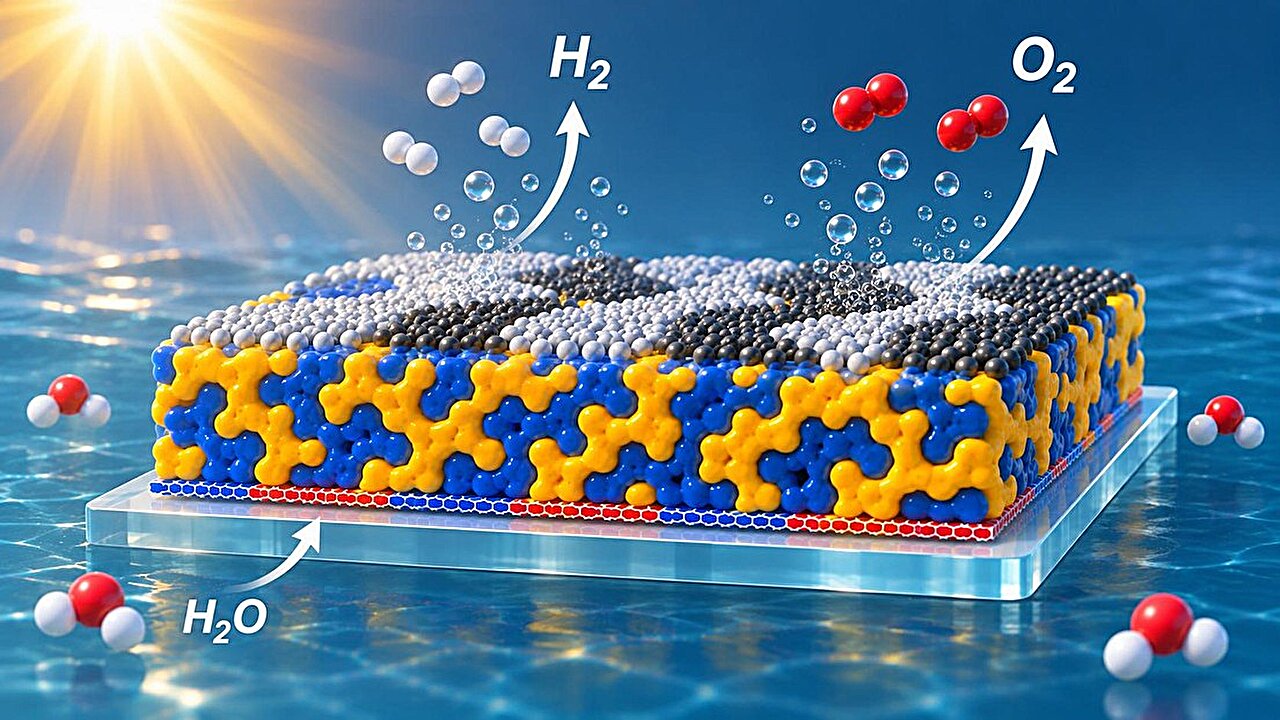
EPFL researchers have shown that a single organic semiconductor layer can drive either hydrogen or oxygen evolution, depending only on the molecular layer beneath it. Using this effect, they built the first organic semiconductor-based photocatalyst sheet that splits water using simulated sunlight with no applied bias.
Photocatalyst sheets combine hydrogen- and oxygen-evolving regions side by side on one conductive substrate. This avoids the external wiring of photoelectrochemical cells and the dissolved redox mediators of particle suspensions, which makes the architecture attractive for large-scale solar hydrogen production. Until now, however, these sheets have relied on inorganic semiconductor particles that are difficult to assemble into a working sheet.
In a study published in Nature Energy, a team led by Dr. Nicolas Diercks and Dr. Jin Su Park of the LIMNO lab at EPFL took a different approach. They deposited a solution-processed semiconducting polymer bulk heterojunction (PBDTTTPD:PNDIHDT) onto FTO substrates modified with self-assembled small molecules whose dipoles point in opposite directions. On a carbazole-based contact (2PACz), the film acts as a photocathode for hydrogen evolution. On a new naphthalimide-based contact (NI-PA), the same film acts as a photoanode for oxygen evolution.
The team patterned the two molecules into microdomains by contact printing, then added platinum and iridium-oxide co-catalysts. The resulting sheet split water without bias for more than 2 hours, producing hydrogen and oxygen in the expected 2:1 ratio.
Source link