Tapping into the country’s strengths in manufacturing and engineering, NVIDIA is helping advance Korea’s physical AI ecosystem.
The country’s industry leaders are applying accelerated computing, AI and simulation to everything from semiconductor manufacturing to robotics and autonomous vehicles.
These efforts are helping bring physical AI from development into real-world production.
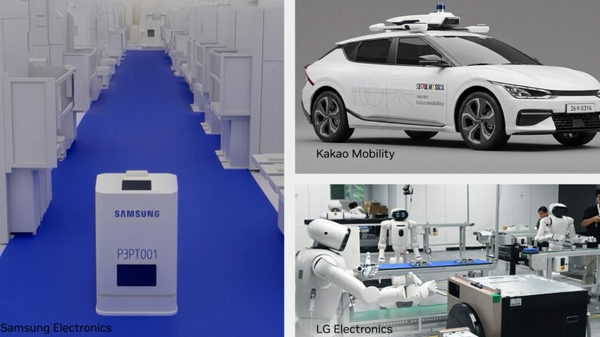
Samsung Electronics is expanding its collaboration with NVIDIA to advance semiconductor innovation through accelerated computing and AI physics. The work spans materials research, process development and device engineering.
In technology computer-aided design, Samsung is working with NVIDIA cuISS and NVIDIA cuDSS to accelerate computations involving sparse linear systems. The collaboration also extends to GPU acceleration for process and optical simulations. In materials research, Samsung’s sMOL platform has run selected quantum chemical calculations up to 5x faster end to end with NVIDIA cuEST. Samsung is also exploring NVIDIA cuEquivariance to speed up tensor operations used in training and inference for atomistic AI models.
Samsung is developing chip-scale thermal and mechanical analysis workflows with NVIDIA PhysicsNeMo. In one AI homogenization case, combining AI-predicted effective material properties, coarser grids and GPU acceleration resulted in a roughly 1,600x speedup. Simulation time fell from about 18 hours for a fine-grid solve on a 32-core CPU to 41 seconds for a GPU-accelerated coarse-grid solve.
Looking ahead, NVIDIA Agent Toolkit could connect these simulation tools and AI models, helping future engineering agents run analyses and compare design options.
Kakao Mobility plans to build on NVIDIA’s autonomous vehicle computing and safety technologies to advance development of a level 4 autonomous driving system.
Source link